

![Pinecrest Real Estate Guide: Acre Lots and EU-1 Estate Zoning [2026]](https://media.agentaprd.com/sites/1210/Pinecrest-Real-Estate-Guide-Acre-Lots-and-EU-1-Estate-Zoning-2026.webp)
One-acre EU-1 estate zoning, the 1996 Village incorporation, Pinecrest Gardens, north vs south price patterns, renovation vs new construction, and how Pinecrest compares to Ponce-Davis and High Pines. From The Audrey Ross Team at Compass Florida.
The Short Answer
Pinecrest is an incorporated village of 7.54 square miles in Miami-Dade County, about 11 miles southwest of downtown Miami, incorporated on March 12, 1996. Its EU-1 estate district sets a one-acre minimum lot, which is why Pinecrest, rather than Coral Gables or Coconut Grove, is the Miami market defined by acre parcels rather than by architecture.
Most Miami neighborhoods are described by what was built on them. Pinecrest is better described by what was never allowed to happen to it. As the surrounding county subdivided through the postwar decades, Pinecrest’s acre-lot pattern held, and incorporation in 1996 converted that inherited pattern into enforceable local code. Thirty years later that single rule is still why a buyer trading out of a Coral Gables house arrives here with a tape measure instead of a mood board.
The Audrey Ross Team has worked this corridor since 1984, 40+ years, from the guard-gated waterfront enclaves along Old Cutler Road to the acre estates west of them. This guide covers what one-acre zoning actually does to value, how the Village came to exist, how the north and south ends of Pinecrest price differently, whether to buy finished new construction or a 1960s ranch on land, and how Pinecrest sits against its northern neighbors, Ponce-Davis and High Pines.
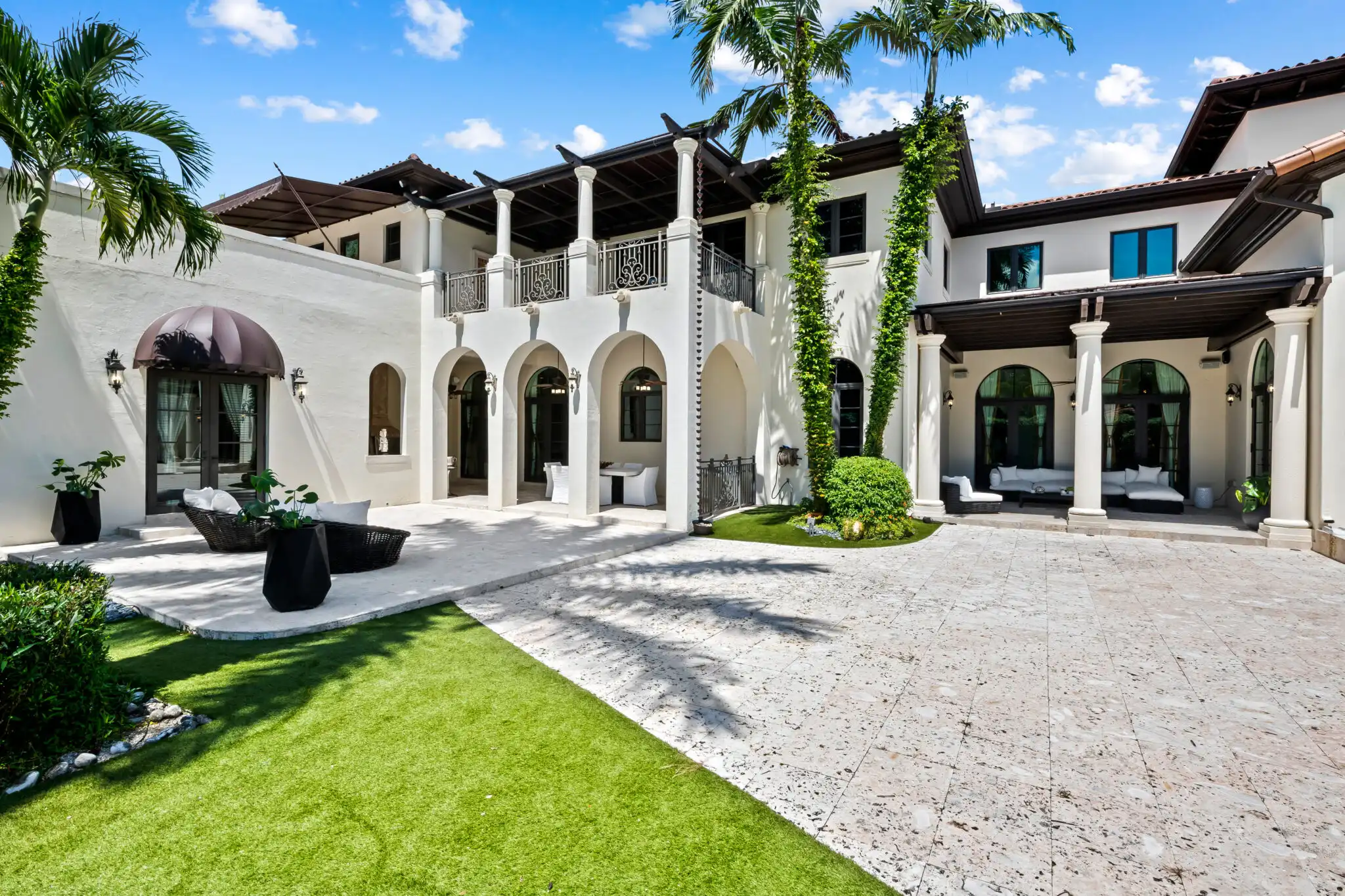
What is Pinecrest, and why does one acre matter?
Pinecrest is an incorporated municipality, not a neighborhood inside another city. It covers 7.54 square miles, of which 7.45 square miles is land, about 11 miles southwest of downtown Miami. U.S. Route 1, signed locally as Pinecrest Parkway, forms its western boundary. Coral Gables lies to the east, South Miami to the north, Glenvar Heights to the northwest, Kendall to the west across the highway, and Palmetto Bay to the south. The 2020 census counted 18,388 residents across 6,232 households, and the village operates under a council-manager government with a five-member Village Council. Miami-Dade County today contains 34 incorporated municipalities; Pinecrest is one of the wave that incorporated in the 1990s.
That municipal status is the whole story. A village with its own council writes its own land development regulations, and Pinecrest’s regulations are unusually protective of lot size. The residential pattern was set in the 1950s and 1960s, when ranch-style houses went up on one-acre lots and gave the area its low-density, heavily canopied character. Incorporation in 1996 turned that inherited pattern into enforceable code.
Where is the one-acre rule actually written?
Pinecrest’s estate districts are written into Chapter 30 of the Village Code of Ordinances. The headline district is EU-1.
| District | Minimum lot area | Maximum density |
|---|---|---|
| EU-1 (estate, one acre) | 1 gross acre | 1 dwelling unit per gross acre |
| EU-1C (estate, two and a half acres) | 2.5 gross acres, including one half of adjacent rights-of-way | 1 principal dwelling unit per 2.5 acres |
| EU-S (suburban estate) | 25,000 gross square feet, including one half of adjacent rights-of-way | Higher than EU-1 |
| EU-M (modified estate) | 15,000 net square feet | Higher than EU-1 |
| RU-1 and RU-2 (single-family residential) | 7,500 net square feet | Higher than EU-1 |
Framework source: Village of Pinecrest Code of Ordinances, Chapter 30 (Land Development Regulations), as published on Municode, read against the Village of Pinecrest official zoning map. Minimum lot areas read from Chapter 30, Article 4, Division 4.2 (Residential districts). Verified August 2026.
Two details matter more than they look. First, the estate standard measures gross acreage, which can include a portion of adjacent rights-of-way, so a parcel that reads as an acre on paper is not always an acre of usable yard. Second, one unit per gross acre means a large parcel cannot be quietly split into two building sites. Density is capped in the code, not at the whim of a future owner. Both points are why a boundary survey and a zoning verification letter belong in diligence rather than in the assumptions column.
What does acre zoning actually do to value?
In most luxury markets, the house carries the price. In Pinecrest, land carries a disproportionate share of it, and the practical consequences are specific.
A full acre absorbs program that a half-acre cannot. Setbacks in one-acre estate zoning are generous, which is why Pinecrest properties routinely accommodate a pool, a guest or staff structure, a sport court, a motor court, a whole-house generator and a genuine buffer of mature landscaping without the compromises a smaller lot forces. It also produces privacy that no amount of construction budget can manufacture on a tighter site.
The second consequence is durability. Supply of one-acre parcels inside a built-out village cannot expand. Buyers are competing for a fixed number of sites, and the land component of value is therefore less sensitive to what happens to construction costs or design fashion. When a Pinecrest house is priced correctly, it is usually priced from the lot up rather than from the square footage down. That is a different valuation exercise than pricing a Coral Gables in-town house, and getting it wrong in either direction is expensive.
How did Pinecrest become a village?
The area’s recorded history begins in the early 1900s, when Miami pioneer and railroad developer Henry Flagler used the property at U.S. 1 and SW 102nd Street as a staging area during construction of the Overseas Railroad, the extension that reached Key West in 1912. The village is named for the pine trees that formerly covered the area, and it was first developed in the 1930s as a neighborhood of larger estates. In 1936 the Parrot Jungle attraction opened on twenty rented acres at Red Road and SW 111th Street, admitting its first visitors on December 20 of that year, and became one of Miami’s earliest tourist landmarks. The residential build-out followed in the 1950s and 1960s with acre-lot ranch houses.
Hurricane Andrew struck in August 1992 and hit this part of southern Miami-Dade hard. In the recovery years, residents concluded that decisions about their zoning, their permitting and their parks were being made too far away, and a resident-led incorporation movement formed. On March 12, 1996, the Village of Pinecrest incorporated.
For a buyer, incorporation is not trivia. It means Pinecrest sets its own residential zoning rather than inheriting county defaults, runs its own building and planning department, and maintains its own parks and tree program. The village maintains five parks, including Coral Pine Park and Evelyn Greer Park, and that park system is part of the reason a one-acre grid still functions as a family-friendly village rather than a row of private compounds. The village is a Tree City USA community and reports having planted more than 10,000 street trees since 1997. It also means permit review, landscape requirements and setback variances are handled locally, which is generally faster but not always more permissive.
Why does Pinecrest Gardens matter to property values?
The attraction’s full name was Parrot Jungle and Gardens. When it relocated to Watson Island, the Village of Pinecrest bought the original site in 2002 rather than let it be subdivided, and it reopened to the public as Pinecrest Gardens in 2003. On October 17, 2011 the property was added to the National Register of Historic Places as the Parrot Jungle Historic District.
What sits there now is a botanical garden and cultural park of roughly 20 acres, organized as Upper Gardens on the pine rockland ridge and Lower Gardens in the hardwood hammock and cypress slough below. It holds mature banyans, a swan lake, a splash pad and playground, preserved Parrot Jungle mosaic pathways and birdcages, and a geodesic dome amphitheater built in the early 1940s and seating about 530, used for a year-round program of concerts, festivals and a fine arts season.
The real estate effect is straightforward. A village that buys its own landmark to keep it from being developed is a village that will keep protecting lot size, and the Gardens function as the walkable civic anchor that an acre-lot neighborhood otherwise lacks.
What do homes cost in Pinecrest?
The most useful answer is that a single Pinecrest median is close to meaningless, and understanding why is worth more to a buyer than any one number. Pinecrest is a bimodal market. An original ranch trading near land value and a finished new build on the identical acre can be separated by many millions, which puts the village-wide median in a band where relatively little inventory actually sits. A median is a good summary statistic for a market of similar houses. Pinecrest is a market of similar lots and wildly dissimilar houses.
That structure also explains why published third-party estimates for Pinecrest disagree with one another so sharply. Automated valuation indices, portal medians and market-report snapshots each draw a different geography, apply a different property-type filter and use a different index method. Some cover the ZIP code rather than the incorporated village boundary, which pulls in parcels the Village does not zone. Reading two of them side by side produces a range, not a price.
| Figure to request | Why it is the one that matters |
|---|---|
| Median closed sale price, Village of Pinecrest boundary | Closed sales only, drawn on the municipal boundary rather than the ZIP, is the only figure tied to the zoning discussed on this page. |
| Closed price per lot acre, split by condition | Separates land value from improvement value, which is the actual Pinecrest decision. |
| Closed price per square foot, new construction vs unrenovated | Quantifies the bimodal gap instead of averaging across it. |
| Median days on market, by price band | Village-wide days on market blends two different products moving at different speeds. |
| Months of supply of true one-acre EU-1 parcels | The scarcity measure that actually drives Pinecrest land pricing. |
What a budget tends to buy in Pinecrest
- Entry range: Original mid-century ranch houses on full or near-full acres, priced close to land value and bought as renovation or replacement sites.
- Mid range: Updated homes and older custom builds on an acre, or newer construction on smaller-than-acre parcels.
- Upper range: Recent new construction on a full acre with impact glazing, current mechanicals and a completed pool and landscape program.
- Top of market: Multi-acre estate parcels, architecturally significant houses, and the small number of waterfront and lakefront sites inside the village.
One practical consequence of all this: when a Pinecrest listing looks mispriced against the village median, it usually is not. It is priced against a different product. The question to ask an agent is not what Pinecrest homes cost, but what parcels of your target lot size, zoning district and condition have actually closed for in the last two quarters, and what the finished comparable on that same block looks like. That is a specific request, and any agent working the village should be able to answer it with closed data rather than a portal screenshot.
How do north and south Pinecrest differ?
Buyers ask this constantly, and the honest framing is that Pinecrest has two axes, not one.
What defines the north end?
The northern edge of the village runs against South Miami, with Glenvar Heights to the northwest. Beyond South Miami and the western edge of Coral Gables sits the Ponce-Davis and High Pines pocket, so the north end is the part of Pinecrest that sits closest to the Gables business district, Coconut Grove, downtown Miami and Brickell. Drive time is the north end’s product, and it is the reason buyers who work in the Gables or Brickell and still want an acre concentrate here. Lot sizes toward the village’s outer edges and the U.S. 1 corridor are less uniformly an acre than the interior.
What defines the south end?
Toward the southern boundary at Palmetto Bay, the acre grid is more continuous and the streets are quieter. This is where the deepest inventory of true one-acre estate parcels sits, along with several gated pockets. Buyers trade a few minutes of commute for a larger contiguous supply of land and, generally, more house and lot for the same money than the north end delivers.
Why does the east-west axis matter as much?
Within Pinecrest, the more useful distinction is often east versus west. Parcels toward the eastern side of the village, closer to Old Cutler Road and the Coral Gables boundary, sit nearer the guard-gated waterfront enclaves and the Old Cutler corridor. Parcels toward U.S. 1 on the western edge trade convenience and retail access for highway proximity. Two houses with identical square footage on the same street can price very differently depending on which direction they sit and what they back onto.
New construction or a 1960s ranch?
This is the central decision in Pinecrest, and it is a real fork rather than a marketing question. The village’s housing stock spans roughly seven decades, from the original 1950s and 1960s ranch houses that established the acre pattern through to current new construction, and both ends of that range are actively traded.
What is the case for new construction?
Miami-Dade County sits in the High-Velocity Hurricane Zone, the most demanding wind-design region in the Florida Building Code. A newly built Pinecrest house delivers current-code roof attachment, impact-rated glazing, modern electrical and plumbing, and insurable systems with documented ages. For a buyer relocating from out of state who does not want to run a construction project remotely, that certainty is the product being purchased, and it is priced accordingly.
What is the case for the 1960s ranch?
The 1960s ranch is how buyers get an acre in Pinecrest at the low end of the market. It trades near land value, which means the house is effectively free and the acre is the asset. Owners who renovate or replace control the design entirely, and on a one-acre EU-1 parcel there is room to site a new structure thoughtfully rather than squeezing it.
The discipline is arithmetic. A ranch purchase is only a good trade when the acquisition price plus a bid-verified construction budget lands meaningfully below a finished comparable on a similar acre. That comparison has to be run before the offer, not after inspection.
Diligence items specific to a Pinecrest acre
- Survey the acre. EU-1 measures gross acreage. Confirm net usable lot area, easements and setbacks with a current boundary survey before you plan a pool, a court or an addition.
- Wastewater. Establish whether the property is on sewer or an on-site septic system, its age and condition, and whether any connection requirement applies.
- Permit history. Pull the Village building department record. Unpermitted additions, enclosed carports and older pool work are common on long-held mid-century houses and become the buyer’s problem at resale.
- Tree protection. The canopy is regulated. Confirm the Village’s tree removal and replacement requirements before assuming a site plan that clears mature specimens.
- Roof and opening protection. Roof age and impact-rated openings drive both insurability and premium. Get a wind mitigation inspection before waiving the inspection contingency.
What schools serve Pinecrest?
School questions come up early in almost every Pinecrest search, and the useful answer is a factual one: which campuses exist, where they sit, and how assignment is determined. Ratings and rankings are published by third parties, change annually, and are not something a brokerage should be interpreting for you. What we can do accurately is confirm the assignment for a specific address before you commit to it.
Which public schools serve Pinecrest?
Pinecrest is served by Miami-Dade County Public Schools, the district that covers all of Miami-Dade County. Miami Palmetto Senior High School is located inside the village at 7431 SW 120th Street on a 23-acre campus in southwest Miami-Dade County. It opened in September 1958 and serves Pinecrest, Palmetto Bay and portions of Kendall, West Perrine and Palmetto Estates.
Attendance boundaries are set by the district, are revised periodically, and do not follow village limits precisely. Some Pinecrest addresses fall outside the general pattern, and the district also operates magnet and choice programs with separate application processes and separate deadlines. Verify the assigned campuses for a specific address directly with Miami-Dade County Public Schools before you write an offer. We check this as part of buyer diligence.
Which independent schools are located in and near the village?
Gulliver Preparatory traces its origins to Gulliver Academy in 1926 and became Gulliver Preparatory School in 1975. It enrolls more than 2,200 students across two campuses serving grades PK through 12, with the Upper School campus located in Pinecrest and the Marian C. Krutulis PK-8 campus in Coral Gables. Other independent schools operate in the wider Coral Gables, South Miami and Palmetto Bay corridor. Independent schools set their own admissions criteria, testing requirements and timelines, and applications typically run a full year ahead of enrollment, which is worth mapping against a closing date rather than discovering afterward.
How does Pinecrest relate to Ponce-Davis and High Pines?
Start with the governance fact, because it is the one most often gotten wrong. Ponce-Davis and High Pines are both unincorporated communities in Miami-Dade County. Neither is a municipality, which is why neither appears as a city on a map and why both are zoned and serviced by the county rather than by a local council. Ponce-Davis takes its name from its two main roads, Ponce de Leon Road at SW 49th Avenue running north to south and Davis Drive at SW 80th Street running east to west. It borders Coral Gables to the north, east and south, South Miami to the west, and High Pines to the northwest. High Pines is bounded by Coral Gables at SW 72nd Street to the north, South Miami at SW 57th Avenue to the west, and Ponce-Davis at School House Road to the east.
Note what those boundaries mean: neither community actually touches Pinecrest. They sit north of it, in the pocket framed by Coral Gables and South Miami, with Coral Gables and South Miami territory in between. Buyers and even some listing copy describe them as adjacent to Pinecrest; they are near it, not on it. The distinction matters for anything driven by jurisdiction, including zoning authority, permitting counter, code enforcement, park access, municipal services and, in some cases, school assignment.
Their governance status has been tested recently. Coral Gables proposed annexing both Ponce-Davis and High Pines in 2018, and Miami-Dade County rejected the proposal in 2019, so both remain unincorporated. A buyer choosing between these pockets and Pinecrest is therefore choosing between county zoning that could be revisited and a village code that has been locally controlled since 1996.
Buyers routinely shop all three, and the trade is clean. Ponce-Davis and High Pines buy proximity: shorter drives to the Gables business district, Coconut Grove, the independent school corridor and downtown. Their lots are generally smaller than a Pinecrest acre, and part of the price is the address itself. Pinecrest buys land and self-government: a full acre under EU-1 zoning, deeper setbacks, and a village council that has protected that pattern since 1996.
The practical way to decide is to write down the program before touring. A buyer whose requirements include a detached guest structure, a pool, a sport court and a motor court on one parcel is describing an acre, and the acre supply is in Pinecrest. A buyer whose binding constraint is drive time to the Gables or the Grove is describing a location, and that location is north of the village. There is no wrong answer, only a clear tradeoff, and it is worth running both sets of comparables against the written program before deciding.
How do flood and windstorm insurance work on an inland Pinecrest acre?
Waterfront risk questions get asked about Miami generally and then applied to neighborhoods where they do not fit. Pinecrest is inland, roughly 11 miles southwest of downtown Miami and not on Biscayne Bay, so its risk profile is different from a bayfront or barrier-island property. Different is not the same as absent, and the answer is parcel-specific.
Flood zone designations vary within the village, including along the Snapper Creek corridor. Lenders require flood insurance on properties in Special Flood Hazard Areas, and many owners outside those areas carry a policy anyway because the premium at preferred-risk pricing is small relative to the exposure. The authoritative check is the FEMA Flood Map Service Center for the exact address, supported by an elevation certificate where one exists.
Windstorm is the larger line item for most Pinecrest owners. Every Miami-Dade property carries hurricane exposure, and Florida policies apply a separate hurricane deductible calculated as a percentage of dwelling coverage rather than as a flat dollar amount. Premium is driven heavily by roof age and material, opening protection, and documented wind mitigation features. On a 1960s ranch, those three items often decide whether the house is economically insurable at all, which is exactly why they belong in the offer analysis rather than the punch list.
The honest takeaway on Pinecrest risk
An inland acre in Pinecrest is a comparatively favorable risk position within Miami-Dade, and homes built to current High-Velocity Hurricane Zone standards with new roofs and impact glazing quote very differently from unimproved mid-century houses. The work is to price insurance before you are emotionally committed, not after. Pull the FEMA map, order a wind mitigation report, and get a real quote during the inspection period. Buyers who do this arrive at closing with no surprises, and sellers who do it before listing rarely lose a contract to an insurance number.
What drives demand for a Pinecrest acre?
Demand in Pinecrest is best understood through property attributes rather than buyer profiles, because the village sells one thing that its neighbors structurally cannot: contiguous land inside a built-out municipality, twenty minutes from a central business district, under a zoning code that caps density at one unit per gross acre.
Three attributes carry most of the demand. The first is program capacity. A full acre absorbs a pool, a detached guest or staff structure, a sport court, a motor court, a whole-house generator and a real landscape buffer at the same time. On a half-acre those uses compete, and the buyer gives one up. The second is fixed supply. The village is built out and the parcel count under estate zoning cannot expand, so buyers are bidding for a set number of sites rather than for units that can be added. The third is regulatory durability. Density here is capped in a code written and enforced by a five-member council one jurisdiction deep, not by a county commission balancing an entire metropolitan area.
Florida’s tax structure sits underneath all of it. Florida levies no personal state income tax, and its constitution prohibits one, which changes the after-tax cost of carrying an expensive house relative to high-tax states. That is a statewide fact rather than a Pinecrest fact, but it is part of why relocation demand across South Florida has been durable, and Pinecrest competes for that demand on land rather than on price.
A meaningful share of Pinecrest transactions is also generational. Acre parcels bought decades ago come to market once, and the next owner frequently renovates or rebuilds rather than reselling quickly. Turnover is unhurried by design, and that low velocity is part of why well-positioned acre parcels hold their footing through cycles. It is also why waiting for the perfect listing is a poor strategy here: in a market with this little annual supply of true one-acre sites, the shortlist is short, and the workable method is to track current Pinecrest listings continuously rather than starting a search from zero when the need appears.
Frequently Asked Questions About Pinecrest Real Estate
What is Pinecrest, Florida known for?
Pinecrest is known for land. It is an incorporated village of about 7.54 square miles in Miami-Dade County, roughly 11 miles southwest of downtown Miami, where the EU-1 estate zoning district sets a one-acre minimum lot area. The neighborhood took its shape in the 1950s and 1960s when ranch-style homes were built on acre lots, and that pattern survives today, which is why acre estates define Pinecrest in a way they do not define neighboring Coral Gables or South Miami. Pinecrest Gardens, the former Parrot Jungle property the Village bought in 2002 and listed on the National Register of Historic Places in 2011, anchors civic life.
Are all lots in Pinecrest one acre?
No. EU-1 is the estate district that gives Pinecrest its character, and it is not the only district in the village. The Village of Pinecrest official zoning map also shows a larger-lot estate district and several smaller-lot residential districts, generally toward the U.S. 1 corridor and the village edges, so lot minimums are not uniform across Pinecrest. Two further details matter: the estate standard is written in gross acreage, which can include a portion of adjacent right-of-way, so a parcel that reads as an acre on paper is not always an acre of usable yard. Always verify the zoning designation and the surveyed lot area of a specific parcel with the Village before you assume it is an acre.
How much do homes cost in Pinecrest?
There is no single meaningful Pinecrest price, because the market is bimodal. An original 1960s ranch on a full acre trades close to land value, while finished new construction on an identical acre can sell for a multiple of that, so a village-wide median sits in a gap where very little actually transacts. Published portal estimates also diverge from each other because each uses a different geography, property-type filter and index method. Ask for closed comparables matched to your target zoning district, lot size and condition rather than a village-wide average.
What schools serve Pinecrest?
Pinecrest is served by Miami-Dade County Public Schools. Miami Palmetto Senior High School sits inside the village at 7431 SW 120th Street on a 23-acre campus, opened in September 1958, and serves Pinecrest, Palmetto Bay and portions of Kendall, West Perrine and Palmetto Estates. Independent options include Gulliver Preparatory, which enrolls more than 2,200 students across two campuses and locates its Upper School in Pinecrest and its Marian C. Krutulis PK-8 campus in Coral Gables. Attendance boundaries are set by the district, are revised periodically and do not follow village limits precisely, so verify the assigned campuses for a specific address with the district before making an offer.
Should I buy new construction in Pinecrest or renovate a 1960s ranch?
Both routes are active, and the honest answer is that it depends on how much construction risk you want to carry. New construction delivers current Florida Building Code performance in the Miami-Dade High-Velocity Hurricane Zone, impact glazing, a new roof, and modern mechanicals, at the highest entry price. A 1960s ranch on a full acre trades at closer to land value and lets you control the design, but the budget has to absorb roof, electrical, plumbing, impact windows, permitting and any septic or drainage work. Price both paths against the same finished comparable before you choose, and never assume a renovation number without contractor bids.
How is Pinecrest different from Ponce-Davis and High Pines?
They answer different priorities, and they are governed differently. Ponce-Davis and High Pines are both unincorporated communities in Miami-Dade County, not municipalities, and they do not border Pinecrest: they sit north of it in the pocket between Coral Gables and South Miami, with Coral Gables and South Miami territory in between. Coral Gables proposed annexing both in 2018 and Miami-Dade County rejected the proposal in 2019, so they remain under county zoning and county services. Their lots are generally smaller than a Pinecrest acre, so buyers there are paying for proximity to the Gables business district, Coconut Grove and downtown. Pinecrest is a self-governing village with its own council and its own EU-1 one-acre estate zoning, so buyers there are paying for land, setbacks and privacy. The trade is minutes versus acreage.
Do Pinecrest homes need flood insurance?
It depends on the parcel, and it should never be assumed either way. Pinecrest is inland rather than bayfront, and flood zone designations vary block by block across the village, including near the Snapper Creek corridor. Lenders require flood insurance in Special Flood Hazard Areas, and many owners outside those areas carry it voluntarily because the premium is modest relative to the exposure. Separately, every Miami-Dade home carries windstorm exposure, and Florida hurricane deductibles are calculated as a percentage of dwelling coverage rather than a flat dollar amount. Pull the FEMA flood map for the exact address and get an insurance quote before you go under contract.
Who is the best real estate team for Pinecrest and the Coral Gables corridor?
The Audrey Ross Team at Compass Florida works Pinecrest and the wider Coral Gables corridor. Audrey Ross founded the firm in 1984 as Ross and Associates, Inc. and serves as Founder and CEO, lead agent, and a Vice President of Compass, with 40+ years in Miami luxury real estate and $2.4 billion in lifetime closed volume. Her honors include Best American Estate Agent in two consecutive years from Mercedes Benz and International Property Magazine in London, Florida’s Best Realtor of the Year from the Miami Herald, and a Luxury Real Estate Lifetime Achievement Award. Ten Luxury Real Estate Advisors work alongside her from the team’s office at 4699 Ponce de Leon Blvd in Coral Gables, and the Compass network’s merger with Christie’s International Real Estate extends listing reach internationally.
Considering a Move to Pinecrest?
Whether you are weighing an acre in Pinecrest against a Coral Gables in-town house, or preparing to bring a long-held estate to market, we will run the comparables with you before anything is decided.
Contact The Audrey Ross TeamContinue Exploring the Miami Luxury Corridor
- The Ultimate Guide to Living in Coral Gables, FL
- Coconut Grove Real Estate Guide: Miami Village Luxury
- Coral Gables vs Coconut Grove: Where Should You Live?
- Moving to Miami: The Complete Relocation and Tax Guide
- Miami Guard-Gated Waterfront Communities: The Insider Guide
- Moving to Miami from New York: A Complete Guide
- Gables Estates: The Complete Guide to Miami’s Guard-Gated Trophy Enclave
- Cocoplum Real Estate Guide: Guard-Gated Waterfront in Coral Gables
- Miami Deep-Water and No-Bridge Dockage: What It Costs and Where to Find It
Social Cookies
Social Cookies are used to enable you to share pages and content you find interesting throughout the website through third-party social networking or other websites (including, potentially for advertising purposes related to social networking).