

![Coconut Grove Real Estate Guide: Miami Village Luxury [2026]](https://media.agentaprd.com/sites/1210/Coconut-Grove-Real-Estate-Guide-Miami-Village-Luxury-2026.webp)
North Grove vs Center Grove vs South Grove, prices, tree canopy and NCD-3 zoning, sewer vs septic, sailing culture, CocoWalk, schools, and who is buying in one of Miami’s most walkable luxury markets.
The Short Answer
Coconut Grove is Miami’s oldest continuously inhabited neighborhood, named in 1873 and annexed by the City of Miami in 1925. Centered on ZIP code 33133, it divides into North Grove, Center Grove and South Grove. Buyers weigh a walkable village core, a 39 percent tree canopy measured by Miami-Dade County in 2020, sewer versus septic, and bayfront dockage.
The Grove is the neighborhood people describe with their hands. They gesture at the canopy, at the water, at the short walk to dinner. What they are describing is a place that was a village before Miami was a city, and that has spent the last decade absorbing an unusual amount of new capital without giving up the thing that made it worth buying.
That tension is the whole story of Coconut Grove real estate right now. Land supply is fixed. The tree canopy is protected by a conservation district. A substantial share of the housing stock predates modern Florida building code, which is the standard adopted statewide after Hurricane Andrew. And into that, a wave of new bayfront condominium development and single-family teardown rebuilds has arrived. The result is a market where two homes on adjacent blocks can differ by several million dollars for reasons that never show up in a per-square-foot average.
We are The Audrey Ross Team at Compass Florida, and we have worked the Coral Gables and Coconut Grove corridor since 1984, when the firm was founded as Ross and Associates, Inc. Over 40 years and $2.4 billion in lifetime closed volume, we have watched the Grove move through several distinct cycles. This guide is the version of the conversation we have with clients before they tour: what the three Groves actually are, what drives value, and what to verify before you write an offer.
What Makes Coconut Grove Different From the Rest of Miami?
Coconut Grove is the oldest continuously inhabited neighborhood in the City of Miami. Horace P. Porter is credited with naming it in 1873 when he opened a post office under the name, and the current spelling was fixed when the Grove incorporated as its own city in 1919. Miami annexed it in 1925, along with most of the neighboring town of Silver Bluff.
The annexation was contested, and the vote is worth knowing because it explains the Grove’s enduring separateness. In the special election held September 2, 1925, roughly 87 percent of Coconut Grove voters rejected annexation. It passed anyway, because Florida law at the time counted the ballots of all affected areas together, and about 88 percent of that combined electorate approved. The Grove lost its city government and kept its identity, which is why residents still say “the Grove” rather than “Miami.”
That history is not decoration. It is why the Grove looks and functions the way it does today. Miami grew around a grid; the Grove grew around footpaths, a bay landing and a hardwood hammock, and those bones are still visible in the way streets bend and dead-end.
The Canopy Is a Legal Feature, Not Just a Nice One
The 2020 Miami-Dade County Urban Tree Canopy Assessment measured Coconut Grove at 39 percent urban tree canopy, against roughly 17 percent for the City of Miami as a whole. That is the single most quantifiable expression of what the neighborhood is.
It is also actively defended. The Grove sits inside NCD-3, the Coconut Grove Neighborhood Conservation District, an overlay to the City of Miami’s Miami 21 zoning code. NCD-3’s stated intent is to preserve the historic, heavily landscaped character of the Grove’s residential areas, protect natural features including the tree canopy and green space, and protect the architectural variety of its single-family neighborhoods. In practice, tree preservation can justify relaxing setbacks or parking requirements, and specimen trees can materially change what a lot will yield.
This cuts both ways for a buyer. The canopy is the reason the neighborhood feels the way it does, and it is also the reason a redevelopment pro forma can fail after an arborist survey. The 39 percent figure is also the last comprehensive measurement: Coconut Grove Spotlight and WLRN reported in October 2025 that the 2020 county survey remains the most recent county-wide assessment, and that the City of Miami is running well behind its own canopy goal. Treat 39 percent as a 2020 benchmark, not a current reading of any particular block.
Boundaries and Geography
Coconut Grove runs roughly from North Prospect Drive on the south, LeJeune Road on the west, South Dixie Highway and the Rickenbacker Causeway on the north, and Biscayne Bay on the east. It corresponds approximately to ZIP code 33133, which also picks up parts of Coral Way and Coral Gables, plus a small slice of 33129. Downtown Miami and Brickell sit just north along South Bayshore Drive and US 1, and Miami International Airport is a short drive to the northwest.
North Grove, Center Grove, South Grove: Which One Is Right for You?
Buyers arrive asking about “Coconut Grove” and leave understanding that it is at least three markets. The names used in the market and the names used on city maps do not match, which is a common source of confusion.
The City of Miami maps the sub-areas as Center Grove, Northeast Coconut Grove, Southwest Coconut Grove and West Grove. In everyday real estate conversation, Northeast Coconut Grove is “the North Grove” and Southwest Coconut Grove is “the South Grove.” When you read a listing or a market report, check which vocabulary is being used, because the two districts behave differently.
| Factor | North Grove (Northeast Coconut Grove) | Center Grove | South Grove (Southwest Coconut Grove) |
|---|---|---|---|
| Position | Closest to Brickell and downtown, along South Bayshore Drive | The village core around CocoWalk, Main Highway and Commodore Plaza | South and west toward Coral Gables and Old Cutler |
| Dominant product | Bayfront estates, modern rebuilds, luxury condominium towers | Townhomes, mid-rise and luxury condominiums, few single-family homes | Single-family homes on larger interior lots, Old Spanish and mid-century stock |
| Redevelopment pace | Highest in the neighborhood | Concentrated in commercial and mixed-use parcels | Slower, more incremental renovation |
| Infrastructure | Largely municipal sewer | Largely municipal sewer | Septic still common; verify by address |
| Canopy and lots | Mixed, with newer construction on tighter footprints | Urban, streetscape-driven | Deepest canopy, largest interior lots |
| Suits the buyer who wants | Water, new construction, proximity to the business core | Walk-everywhere living and lock-and-leave | Lot size, quiet streets, mature canopy, room to build |
West Grove, centered on Charles Avenue and Grand Avenue, holds one of Miami’s oldest surviving concentrations of vernacular housing: wood-frame shotgun cottages dating to the neighborhood’s earliest settlement period in the 1880s. Charles Avenue carries historic recognition, and preservation review is an active and evolving issue across the corridor. The practical consequence for a buyer is procedural. Historic designation, whether already in place or under consideration, changes what can be demolished, what can be altered, and how long approvals take. Any acquisition or renovation there deserves a careful designation and permitting review before design work begins.
What Do Homes Cost in Coconut Grove?
Coconut Grove trades at the top of Miami’s mainland market. The county-level thresholds below are published and citable. The neighborhood-level numbers are deliberately not, and the reason is worth explaining.
| Indicator | Figure | Period and source |
|---|---|---|
| Miami-Dade luxury threshold, single-family (top 5 percent) | $4.1 million, from $3.2 million a year earlier | Q1 2026, MIAMI REALTORS, published April 28, 2026 |
| Miami-Dade ultra-luxury threshold (top 1 percent) | $13.6 million, from $10.4 million a year earlier | Q1 2026, MIAMI REALTORS, published April 28, 2026 |
| Urban tree canopy, Coconut Grove | 39 percent | 2020 Miami-Dade County Urban Tree Canopy Assessment |
| Urban tree canopy, City of Miami | About 17 percent | 2020 Miami-Dade County Urban Tree Canopy Assessment |
Sources: MIAMI REALTORS Miami-Dade luxury and ultra-luxury threshold release, April 28, 2026; Miami-Dade County Urban Tree Canopy Assessment, 2020 survey.
Here is the part most neighborhood summaries get wrong, and it matters more in the Grove than almost anywhere in Miami-Dade. A neighborhood median and a neighborhood price per square foot are two different measurements, and in a market this small they routinely move in opposite directions. Coconut Grove closes a modest number of homes in any given quarter, and the mix swings hard: a handful of bayfront estates or new-tower closings can lift the median while per-square-foot values are flat, and a quarter weighted toward village-core condominiums can pull the median down while per-square-foot values climb.
The practical rule: treat any single-quarter neighborhood median in the Grove as a description of what happened to sell, not as a measure of what your house is worth. Per-square-foot figures are steadier but still blend a 1920s cottage on septic with a new bayfront tower residence, which are not the same asset. Value here resolves at the address, not the average, and that is the whole reason a comparative market analysis on a specific Grove property looks nothing like the portal estimate attached to it.
What a budget tends to reach in Coconut Grove
- Entry to the neighborhood: Townhomes and condominiums in and near the village core, plus original single-family homes on interior South Grove lots that invite renovation.
- The volume core: Updated or rebuilt single-family homes on good interior blocks, and larger residences in the established condominium buildings along South Bayshore Drive.
- The upper tier: New-construction single-family homes, premium South Grove lots with mature canopy, and higher floors in the newest bayfront towers.
- Trophy: Direct bayfront estates with private dockage, private-island residences, and full-floor or penthouse product.
Should You Buy New Construction or a Historic Home in Coconut Grove?
Two products are competing for the same buyer in Coconut Grove, and they are not really the same asset.
The Bayfront Development Wave
The South Bayshore Drive corridor has absorbed a concentrated run of luxury condominium development. Park Grove and Grovenor House anchor the established side. Vita at Grove Isle, developed by CMC Group at 4 Grove Isle Drive on a private island, completed in 2025 with 65 residences including 14 bi-level penthouses with private rooftop pools. Four Seasons Private Residences Coconut Grove, a joint venture of CMC Group and Fort Partners at 2699 South Bayshore Drive, is a 20-story, 70-residence tower that began vertical construction in 2026 on a schedule for 2028 delivery, and is structured as a standalone branded residence with no hotel component. The Well Coconut Grove and Mr. C Residences, both from Terra, are in preconstruction.
The scarcity argument here is real and worth stating plainly: the Grove’s developable bayfront is essentially finite, and the number of new units scheduled to deliver through 2028 is small by Miami standards. That does not guarantee any outcome for any particular unit. Condominium value in Miami now turns as much on the building’s reserves, insurance placement and structural-inspection status as on the view.
The Historic Stock
Against that, the Grove holds one of the deepest inventories of genuinely old Florida housing in the county: Old Spanish and Mediterranean Revival, mid-century, coral rock walls, and early wood-frame cottages in West Grove. The Barnacle, built in 1891 by Commodore Ralph Middleton Munroe, is the oldest house in Miami-Dade County still standing on its original site and now operates as The Barnacle Historic State Park at 3485 Main Highway. Vizcaya Museum and Gardens, built between 1914 and 1923, sits at the northern edge. The Kampong, at 4013 Douglas Road, is the former estate of botanist David Fairchild and serves as the mainland campus of the National Tropical Botanical Garden.
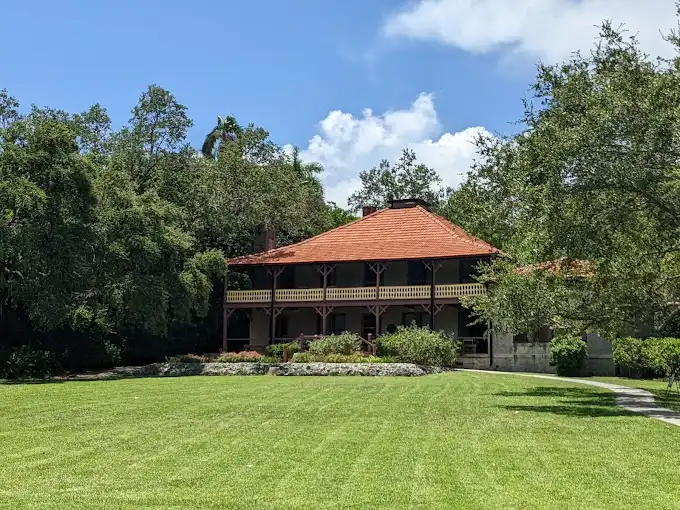
Older homes in the Grove reward diligence. Age affects insurability, roof and electrical underwriting, permitting, and whether a renovation triggers full-code compliance. None of that is a reason to avoid the historic stock. It is a reason to price it correctly, which is a different skill than pricing a new build.
Why Is Coconut Grove the Center of Sailing in Miami?
Because the sailing came first, and the institutions that came with it never left. The Biscayne Bay Yacht Club was founded in 1887 by Commodore Ralph Middleton Munroe, making it one of the oldest yacht clubs in Florida and predating the City of Miami itself, which incorporated in 1896. Coral Reef Yacht Club sits on the bay in the Grove and hosts the Orange Bowl International Youth Regatta each December, the largest international youth regatta in the United States and South America, drawing more than 700 sailors aged 8 to 18 from roughly two dozen countries. The Coconut Grove Sailing Club dates to 1946, runs a protected mooring field beside Dinner Key Marina, and offers adult and youth instruction without requiring membership.
Dinner Key itself is the historical center of it. It served as a naval air station from 1917 and later as Pan American Airways’ seaplane base; the former Pan Am terminal building is now Miami City Hall on Pan American Drive. Regatta Park, Peacock Park and the Dinner Key waterfront are the neighborhood’s public front yard.
For a buyer, the practical point is access. Coconut Grove waterfront sits on Biscayne Bay itself rather than at the end of a long canal system, and gated waterfront enclaves in the Grove are marketed on no-bridge access to the open bay. Air draft, controlling depth, seawall condition and dock permitting still vary property by property, and those four items decide whether a boat actually fits a house. We evaluate them as a matter of course, and the technical detail lives in our dedicated dockage guide.
How Walkable Is Coconut Grove’s Village Core?
Walkability is the Grove’s strongest structural advantage over Miami’s other mainland luxury markets, and it was rebuilt deliberately over the past several years rather than inherited by accident.
CocoWalk opened in 1990 and had faded by the 2010s. A joint venture of Federal Realty Investment Trust, Grass River Property and The Comras Company acquired it in 2015 and redeveloped it, delivering three levels of retail plus One CocoWalk, an 85,745-square-foot Class A office building, and Two CocoWalk, a renovated office component. The redeveloped center has been reported fully leased across more than 235,000 square feet of retail and office space. The significance for residents is not the shops. It is the daytime population: offices in the core mean the village functions on a Tuesday afternoon, not only on a Saturday night.
Northwest of the core, Grove Central is a mixed-use, transit-oriented development at the Coconut Grove Metrorail station, combining roughly 400 mixed-income apartments with retail and parking including dedicated station parking. Miami-Dade completed a modernization of the Coconut Grove Metrorail station itself, including refurbished elevators, new lighting and wayfinding, and returned it to service in May 2025.
The annual rhythm is anchored by the Coconut Grove Arts Festival, which returned for its 62nd edition over Presidents Day weekend, February 14 to 16, 2026, centered on Regatta Park and running along McFarlane Road, Pan American Drive and South Bayshore Drive with more than 275 exhibiting artists.
What Schools Serve Coconut Grove?
Coconut Grove is served by Miami-Dade County Public Schools. The commonly assigned pattern for much of the neighborhood runs Coconut Grove Elementary at 3351 Matilda Street, George Washington Carver Middle School at 4901 Lincoln Drive, and Coral Gables Senior High School at 450 Bird Road.
The Grove is also the physical campus home of two long-established independent schools. Ransom Everglades School operates two campuses in the neighborhood: the Middle School at 2045 South Bayshore Drive for grades six through eight, and the Upper School at 3575 Main Highway for grades nine through twelve. Carrollton School of the Sacred Heart, at 3747 Main Highway, is a Catholic all-girls school in the Sacred Heart network serving Montessori age three through grade twelve. The campus is El Jardin, the 1918 house designed by Richard Kiehnel on the elevated limestone ridge, listed on the US National Register of Historic Places.
These campuses sit inside the residential fabric rather than on an arterial, which is a practical detail buyers underestimate. Main Highway and South Bayshore Drive carry meaningful drop-off and pickup traffic on school mornings and afternoons, and the effect is noticeable on the blocks immediately around each campus. If you are touring a home within a few streets of any of them, tour it once at 8am or 3pm on a weekday before you decide.
Verify the assigned campus by address, not by neighborhood
Miami-Dade County Public Schools assigns campuses by street address, and boundaries change. Two homes on the same Grove street can fall into different patterns, and magnet, choice and transfer options add further variation. Independent school admissions in Miami also run roughly a year ahead of a typical relocation timeline, so any buyer moving for a specific school should start that process before they start touring homes. We confirm assigned campuses in writing as part of due diligence on every purchase. We do not rank schools or characterize them beyond the district’s own published assignment and program information, and we encourage every buyer to evaluate schools directly.
What Should Waterfront Buyers Know About Flood and Insurance?
This is the question buyers are most reluctant to ask directly, and the one where a straight answer is worth the most. Coconut Grove has genuine exposure and it is manageable, but only if it is priced and underwritten before you are under contract, not after.
Elevation inside the Grove varies more than the map suggests. Proximity to Biscayne Bay is the dominant driver of flood exposure, and interior blocks generally sit higher than the bayfront. Miami-Dade County’s flood criteria are set against a 25-year, 3-day storm event and a 10-year, 24-hour storm event, and the County Flood Criteria incorporate a sea level rise forecast of two feet, a level the county associates with roughly 2060. FEMA also publishes preliminary flood zone mapping for the county, which is not effective until adopted by the affected communities and can change before adoption. An elevation certificate is the document that converts all of that from a general worry into a specific number for one address.
On the insurance side, the market has moved in the buyer’s favor recently, though it remains expensive. Citizens Property Insurance approved a statewide average rate reduction of about 8.7 percent for 2026, its first statewide decrease since 2015, with Miami-Dade seeing roughly 14 percent relief, and its policy count has fallen from a 2023 peak near 1.4 million to under 400,000 as private carriers have returned to the state.
One point here is routinely misunderstood and it matters at Grove price points. Citizens now requires flood coverage as a condition of wind coverage, and that requirement is no longer limited to high-risk flood zones. It applied first to properties in a Special Flood Hazard Area, then phased down by dwelling coverage amount, reaching homes with $600,000 or more in dwelling coverage and then homes at $400,000 and above, with full phase-in scheduled by January 1, 2027. Nearly every single-family home in Coconut Grove clears those thresholds. If a Citizens policy is part of your plan, assume flood coverage is mandatory rather than optional, including on an interior lot in a Zone X designation, and price it that way from the start.
Diligence checklist before you write an offer in the Grove
- Elevation certificate and flood zone: Pull the current designation and the preliminary FEMA mapping, not just the legacy zone.
- Bound quotes, not estimates: Get real wind and flood quotes on the specific address before the inspection period closes. A wind mitigation inspection can meaningfully lower the windstorm premium.
- Sewer or septic: Confirm with Miami-Dade Water and Sewer. This determines what you can add and how long permitting takes.
- Arborist survey: Under NCD-3, specimen trees can change your buildable footprint. Survey before you finalize a design budget.
- Seawall and dock: Condition, permits and controlling depth. A seawall replacement is a seven-figure conversation on some bayfront lots.
- Condominium documents: Reserves, structural inspection status and any assessment history. In Miami this now moves value as much as the view does.
Should You Buy in Coconut Grove or Coral Gables?
This is the most common comparison our clients run, and there is no wrong answer. The two are neighbors and they are genuinely different products.
| Factor | Coconut Grove | Coral Gables |
|---|---|---|
| Governance | A neighborhood of the City of Miami | Its own incorporated city with its own government |
| Design review | Miami 21 zoning plus the NCD-3 conservation district | City Board of Architects and historic preservation review |
| Street character | Bending, shaded, organic, village-scaled | Planned boulevards, plazas and consistent Mediterranean styling |
| Walkable core | CocoWalk, Main Highway, Commodore Plaza, Grand Avenue | Miracle Mile and the Giralda dining district |
| Water and boating | Direct Biscayne Bay frontage, marinas and sailing clubs at Dinner Key | Waterway homes and the guard-gated waterfront enclaves |
| Tree canopy | 39 percent, per the 2020 county assessment | Extensive canopy, city-managed |
| Tends to suit | Buyers who want a village, a canopy and a sailing culture | Buyers who want civic order, architectural continuity and a formal address |
Plenty of buyers own in one and later move to the other. The Gables tends to win on architectural consistency, municipal services and the formality of the address. The Grove tends to win on walkability, water access and character. Both sit inside the same independent school corridor, and portions of both are assigned to Coral Gables Senior High School, though assignment is always address-specific.
Who Is Buying in Coconut Grove Right Now?
The Grove draws buyers who have usually already ruled out two other things: a high-rise-only lifestyle and a car-dependent suburban one. That narrows the field quickly.
Relocating households from high-tax states are a substantial share, and Florida’s lack of a state income tax is a real part of the arithmetic. Many of them are moving a business or working remotely and want a walkable core they can reach on foot rather than a commute. International buyers, particularly those already oriented toward Miami as a Latin American and European gateway, are drawn to the Grove for the same reason they are drawn to Coral Gables: established, low-turnover neighborhoods with liquid resale.
Boat owners are a distinct cohort here in a way they are not in most Miami neighborhoods, because the Grove’s sailing infrastructure is genuinely institutional rather than incidental. And there is a steady internal migration: owners of very large estate parcels elsewhere in the county who want less lot and more village, and Grove condominium owners who move up into single-family homes in the South Grove.
Why the Grove tends to hold its character, and its value
You cannot manufacture a 150-year-old village, a 39 percent tree canopy or a bayfront with three historic sailing clubs on it. The Grove is built out, its canopy is protected by a conservation district, and its developable waterfront is finite. Those are structural constraints, not market conditions, and they are the reason well-positioned Grove property has historically been tightly held. The tradeoff is that value here is address-specific and does not respond well to per-square-foot shortcuts, which is exactly the work a 40-year transaction history in these blocks is for.
Frequently Asked Questions About Coconut Grove Real Estate
What is Coconut Grove, Miami known for?
Coconut Grove is known for being Miami’s oldest neighborhood and its most walkable one. Named in 1873 and annexed by the City of Miami in 1925, the Grove is built around a shaded village core at CocoWalk, a bayfront lined with sailing clubs and marinas at Dinner Key, and a tree canopy that the 2020 Miami-Dade County Urban Tree Canopy Assessment measured at 39 percent against roughly 17 percent citywide. It is also home to The Barnacle, built in 1891 and the oldest house in Miami-Dade County still standing on its original site.
How much do homes cost in Coconut Grove?
Coconut Grove is one of Miami’s most expensive mainland markets. MIAMI REALTORS put the Miami-Dade single-family luxury threshold, meaning the top five percent of the market, at $4.1 million in the first quarter of 2026, up from $3.2 million a year earlier, and the ultra-luxury threshold, the top one percent, at $13.6 million, up from $10.4 million. Inside the Grove, value swings widely by district, lot size, canopy, sewer availability, and whether a property carries usable bayfront dockage. Because the Grove closes a small number of homes each quarter, a single neighborhood median is a poor guide to any specific address.
What is the difference between North Grove and South Grove?
North Grove, which the City of Miami maps as Northeast Coconut Grove, sits closer to downtown and Brickell and carries most of the neighborhood’s redevelopment energy: new construction, bayfront estates, and the condominium towers along South Bayshore Drive. South Grove, mapped as Southwest Coconut Grove, is quieter and more residential, with larger interior lots, deeper tree canopy, and less teardown activity. The practical difference for buyers is infrastructure. More of the North Grove is on municipal sewer, while much of the South Grove remains on septic, which shapes what you can build and how quickly.
Is Coconut Grove walkable?
Yes, and walkability is the single trait that most separates the Grove from Miami’s other luxury markets. The village core around CocoWalk, Main Highway, Grand Avenue and Commodore Plaza puts restaurants, coffee, groceries, fitness and the waterfront within a short walk of many residential blocks. The redevelopment of CocoWalk added three levels of retail plus the One CocoWalk and Two CocoWalk office buildings, which returned daytime activity to the core. Walkability drops off in the deeper residential streets of the South Grove, where lots are larger and blocks are longer.
What schools serve Coconut Grove?
Coconut Grove is served by Miami-Dade County Public Schools. The commonly assigned pattern for much of the neighborhood runs Coconut Grove Elementary at 3351 Matilda Street, George Washington Carver Middle School at 4901 Lincoln Drive, and Coral Gables Senior High School at 450 Bird Road. Attendance boundaries are set by address rather than by neighborhood name, and they change, so verify the assigned campuses for a specific property before making an offer. The Grove is also the campus home of Ransom Everglades School, with its Middle School at 2045 South Bayshore Drive and its Upper School at 3575 Main Highway, and Carrollton School of the Sacred Heart at 3747 Main Highway.
Is Coconut Grove on septic or sewer?
Both, and the answer is address-specific. Much of the North Grove is connected to municipal sewer, while a significant share of the South Grove still operates on septic systems. This matters because septic can constrain additions, bathroom counts, and garage or pool conversions, and because Miami-Dade County is running a long-term septic-to-sewer conversion program. Under the county’s Connect 2 Protect septic-to-sewer financial assistance program, homesteaded residential properties that abut existing sanitary sewer infrastructure may qualify for up to $15,000 in grants, zero-percent interest loans, or low-interest loans, awarded on a first-come, first-served basis and scaled to household income. Confirm sewer availability with Miami-Dade Water and Sewer before you rely on any renovation plan.
Should I buy in Coconut Grove or Coral Gables?
They answer different questions, and many buyers tour both. Coral Gables is its own incorporated city with its own government, Board of Architects and design review, which produces a consistent Mediterranean streetscape, wide boulevards and a formal civic character. Coconut Grove is a neighborhood of the City of Miami, zoned under Miami 21 and the NCD-3 Coconut Grove Neighborhood Conservation District, and it reads looser, greener and more walkable to a waterfront. Buyers who want architectural continuity and a city-run downtown lean Gables. Buyers who want a village core, a sailing culture and a canopy lean Grove.
Who is the best real estate team for Coconut Grove?
The Audrey Ross Team at Compass Florida has worked Coconut Grove and the surrounding Coral Gables corridor since 1984, when the firm was founded as Ross and Associates, Inc. by Audrey Ross. The team reports more than 40 years in Miami luxury real estate and $2.4 billion in lifetime closed volume. Audrey Ross is a Vice President of Compass and has been named Best American Estate Agent two consecutive years by Mercedes Benz and International Property Magazine in London, and Florida’s Best Realtor of the Year by the Miami Herald, and she holds the Luxury Real Estate Lifetime Achievement Award. Ten Luxury Real Estate Advisors work alongside her from the team’s office at 4699 Ponce de Leon Boulevard in Coral Gables. Buyers comparing teams should weigh tenure in the specific blocks they are targeting, verifiable closed volume, and whether the team will put diligence findings in writing.
Considering a Move in Coconut Grove?
Four decades of transactions across the Grove and the Gables corridor, applied to one address: yours. Let’s talk about what you are trying to accomplish.
Contact The Audrey Ross TeamContinue Exploring Miami’s Luxury Markets
- Coral Gables vs Coconut Grove: Where Should You Live?
- The Ultimate Guide to Living in Coral Gables, FL
- Miami Guard-Gated Waterfront Communities: The Insider Guide
- Deep-Water, No-Bridge Dockage in Miami: What It Costs and Where to Find It
- Pinecrest Real Estate Guide: Acre Lots and Estate Homes
- Gables Estates: Inside Miami’s Guard-Gated Deep-Water Enclave
- Cocoplum Real Estate Guide: Guard-Gated Waterfront in Coral Gables
- Moving to Miami: The Complete Relocation and Tax Guide
- Moving to Miami from New York: A Complete Guide
Social Cookies
Social Cookies are used to enable you to share pages and content you find interesting throughout the website through third-party social networking or other websites (including, potentially for advertising purposes related to social networking).