

![Miami Guard-Gated Waterfront Communities: The Insider Guide [2026]](https://media.agentaprd.com/sites/1210/Miami-Guard-Gated-Waterfront-Communities.webp)
Gables Estates, Cocoplum, Tahiti Beach, Journey’s End, Snapper Creek Lakes, Old Cutler Bay, Hammock Oaks and Gables by the Sea compared: gate type, membership approval, no-bridge dockage, lot character and price tier.
The Short Answer
Miami’s guard-gated waterfront communities line Old Cutler Road in Coral Gables: Gables Estates, Cocoplum, Tahiti Beach, Journey’s End, Snapper Creek Lakes, Old Cutler Bay, Gables by the Sea, and Hammock Oaks. They differ on three things: whether the gate is staffed 24 hours, whether a club must approve buyers, and whether dockage reaches Biscayne Bay without a fixed bridge.
Miami has dozens of neighborhoods with a gate across the entrance. It has fewer than a dozen where the gate is staffed around the clock, the canals are cut deep enough for a serious vessel, and the water reaches Biscayne Bay without passing under a fixed bridge. Adding up the published home counts for the eight communities in this guide gives a market of roughly 1,200 to 1,600 mainland homes, and the subset that satisfies all three conditions at once is smaller still. Almost all of them sit within a few miles of one another along a single road.
That road is Old Cutler. It runs south from Cocoplum Circle past Matheson Hammock Park and Fairchild Tropical Botanic Garden, under a canopy of banyan and live oak, and every significant guard-gated waterfront enclave in Coral Gables opens off it. Our firm has been transacting inside these gates since 1984, when it was founded as Ross and Associates, Inc. Over more than 40 years and 2.4 billion dollars in lifetime closed volume, we have watched these communities move through every cycle Miami has produced.
This guide is written the way we brief our own clients before they tour. What separates a gated community from a guard-gated one. Which enclaves require you to be approved by a club before you are permitted to close. What no-bridge access actually means for a boat, and what it does to a price. Where the lots are an acre and where they are two. How to think honestly about flood zones and insurance on waterfront property without either panicking or pretending the question does not exist. If you are evaluating Miami’s guard-gated waterfront market, this is the full picture.
What is the difference between a gated and a guard-gated community in Miami?
Buyers use the two terms interchangeably. Sellers, insurers and association attorneys do not. The distinction is operational, it is expensive, and it is the first thing worth getting straight because it drives both the assessment and the resale story.
Gated: a barrier, not a person
A gated community controls entry mechanically. A clicker, a keypad, a call box, a resident transponder. The barrier is real and it deters casual traffic, but nothing is staffed. Guests announce themselves to an intercom, vendors are buzzed through, and there is no log of who came and went. Many perfectly desirable Miami neighborhoods work exactly this way, and there is nothing wrong with it. It is simply a different product.
Guard-gated: a staffed post, 24 hours
A guard-gated community keeps a person at the entrance around the clock. Every visitor, contractor and delivery is screened and recorded by a human being. The best of these enclaves layer more on top: roving patrol vehicles inside the community, marine patrol on the canals and lagoons, camera coverage, and in some cases off-duty municipal police support.
Gables Estates publishes the most detailed roster in the corridor, and it is a useful benchmark for what the top of this market actually buys. The Gables Estates Club states on its own security page that it maintains 24-hour armed guards at both entrances and exits through the contract security firm G4S, 24-hour patrol cars running constant surveillance on each street, boat patrols covering members’ yachts and watercraft, and numerous cameras monitored around the clock across entrances, exits, streets and waterways, including FLIR night-vision cameras and beam detectors. The club also describes an off-duty program with the Coral Gables Police Department that adds police presence beyond the city’s baseline coverage.
Staffing is not free. A single 24-hour post is 168 staffed hours a week, which is more than four full-time positions before relief, benefits and supervision are counted, and before you add vehicles, a marine unit or camera infrastructure. That cost lands in the assessment, and it is the honest reason guard-gated dues sit well above gated ones.
The third tier: membership-approval communities
A small number of Miami enclaves add a layer that has nothing to do with the physical gate. In these communities, membership in a private club or association is a prerequisite to purchase. A signed contract and cleared funds are not sufficient. The buyer must apply, be sponsored, be interviewed or presented to a board, and be admitted. Gables Estates and Snapper Creek Lakes are the clearest examples in Miami, and both clubs say so in their own published material. Tahiti Beach operates its own version inside Cocoplum. This is the layer that most often surprises out-of-market buyers, and it is the layer that most often derails a contract that was written without accounting for it.
The three questions that actually separate these communities
- Is the gate staffed? Twenty-four hour post with roving patrol, or a clicker on a pedestal.
- Can you be turned down? Some communities require club or association approval before a sale can close, with sponsors, references and a board presentation.
- Does the water reach the bay without a bridge? A fixed bridge anywhere in the route caps the air draft of every vessel that will ever use that dock.
How do Miami’s guard-gated waterfront communities compare?
The table below is the working reference we use with clients. Read it as a starting map, not a substitute for association documents. Home counts, fee structures and access details are published inconsistently across public sources, so the table says “Not published” wherever no authoritative figure exists rather than estimating one.
| Community | Gate type | Approval required to buy | Biscayne Bay access | Lot character | Reported price range |
|---|---|---|---|---|---|
| Gables Estates | Guard-gated. Club states 24-hour armed guards (G4S) at both entrances and exits, 24-hour patrol cars, boat patrols, FLIR night-vision cameras and beam detectors, plus a Coral Gables Police off-duty program | Yes. The club states on its own site that membership in Gables Estates Club, Inc. is a prerequisite to purchasing property | Wide, deep-water, sea-walled canals; community sources report bridge-free access to Biscayne Bay | 192 lots per the club; averaging roughly 1.3 acres with the largest parcel reported near 5.4 acres | Listings reported 2.3M to 57M; Zillow put the typical home value near 21M on data through July 2025 |
| Cocoplum | Guard-gated with roving security | Association membership and approval; one-time Phase 2 fee reported at 35,000 | Canals to the Gables Waterway and the bay; clearance varies by section | Phase 1 reported near 140 homes, Phase 2 near 300; roughly half on water | Trailing 12-month median reported near 9.0M |
| Tahiti Beach Island | Second gate inside Cocoplum | Yes, separate one-time fee reported at 100,000 | Bayfront and canal, private docks plus marina handling large yachts | Reported between 20 and 29 homes; lots often above 25,000 sq ft | Listings reported 3.2M to 30M; trade press reported a March 2026 sale at 32M as a community record, above a 2021 record reported at 28.9M |
| Journey’s End | Guard-gated, 24-hour security with roving patrol per community sources | Not published | Private marina and docks; community sources report direct bay access with no bridges | 18 estates; community sources describe lots of more than one acre, ranging to roughly five | Not published |
| Snapper Creek Lakes | Guard-gated, 24 hours, roving security | Yes. The club’s own 2024 membership application requires the purchase contract to be made subject to the buyer being approved into membership, with a 100,000 non-refundable application fee and four member sponsors | Two private lakes and a marina; community and brokerage material describes one bridge between the channel and the bay | 124 lots per the club, all reported at one acre or more; 30 lakefront, 6 with direct bay access | Listings reported 1.6M to 19M |
| Old Cutler Bay | Guard-gated. The HOA describes a 24-hour guard-gated entrance, continuous roving patrols and a camera-equipped guard house. A separate Old Cutler Bay Security Guard Special Taxing District exists and was moved to City of Coral Gables governance under County Resolution R-1023-17 and City Resolution R2017-88 | No. The HOA states membership is voluntary and that it does not regulate property ownership or home purchases | Canal homes with direct access to Biscayne Bay and no fixed bridges, per the HOA | The HOA states just over 100 single-family homes; third-party sources report 136 homes on about 150 acres | Not published |
| Hammock Oaks and Hammock Lakes | Gated with staffed entry | Not published | Lakefront plus a marina area; brokerage material describes one bridge to the bay | Reported 100 to 160 homes; lot and home size ranges vary by source | Reported roughly 1.4M to 10.9M |
| Gables by the Sea | Community and brokerage sources describe a 24-hour guarded entrance | Not published | Deep-water canals with reported no-bridge access | Published counts vary widely, from roughly 360 to roughly 520 residences; majority canal-front or bayfront | Interior lots reported 1.5M to 2.5M; full sea access 5M to 10M |
As of July 2026. Compiled by The Audrey Ross Team. Primary sources: Gables Estates Club, Inc. (lot count, membership prerequisite, published security roster); the Snapper Creek Lakes Club and its 2024 New Member Application (lot counts, application fee, sponsor and interview requirements); the Old Cutler Bay Homeowners Association (home count, voluntary association, security); and the Islands of Cocoplum Homeowners Association Phase II (fee coverage and 24-hour security). Home counts, fees and access details for Cocoplum, Tahiti Beach, Journey’s End, Hammock Oaks, Hammock Lakes and Gables by the Sea come from secondary community and brokerage material and are flagged accordingly.
Gables Estates: the membership-approval standard
Gables Estates is the reference point against which every other Miami guard-gated community gets measured. It was developed beginning in the early 1960s by Arthur Vining Davis, the industrialist behind Alcoa and the Arvida Corporation, and it was designed from the start around water rather than around a golf course or a clubhouse.
The club states on its own website that the community “encompasses over two hundred acres of Coral Gables’ shoreline” and “encompasses 192 lots with wide, deep water, sea walled canals.” Third-party parcel analysis puts the average lot near 1.3 acres and the largest near 5.4 acres. Community sources describe direct, bridge-free access to Biscayne Bay, and that detail is the entire architecture of the place: a vessel can leave a private dock and be in open bay water without a clearance calculation. Dockable length and controlling depth vary materially by canal segment and must be verified per address rather than assumed from the community name.
Zillow’s home value analysis on data through July 2025 identified Gables Estates as the most expensive neighborhood in the United States, ahead of the better-known California enclaves, with a typical home value reported near 21 million dollars. That ranking is worth understanding correctly: it is a measure of typical home value across a small, unusually homogeneous set of very large waterfront parcels, not a claim about any individual property, and it is not a median sale price.
The approval process
Gables Estates Club, Inc. states plainly on its own site that “Membership in the Gables Estates Club, Inc., is a prerequisite to purchasing property.” That single sentence is the governing fact, and it means an executed contract and cleared funds are not sufficient to close.
Beyond that, the club does not currently publish its application terms. As of July 2026 the membership and procedures documents posted on the club’s own applications page return a placeholder reading that new documents are being uploaded. Community and brokerage sources describe a non-refundable application fee reported at 100,000 dollars or more, resident sponsorship, a background and financial review, and approval by the club. We are deliberately not restating a detailed fee schedule or sponsor count for Gables Estates, because the figures circulating publicly are not traceable to the club and in several cases appear to have been carried over from a neighboring community’s published rules.
One timing fact is published and it matters more than the fee. The club’s Board of Governors meets a minimum of four times a year, with a semi-annual meeting each April and an annual meeting each November. The approval calendar therefore belongs to the board, not to the buyer or the seller, and a contract written to a generic 30-day approval window can miss a meeting cycle entirely. A contract on a Gables Estates property that does not address approval timing, deposit protection and the sequence of contingencies has a structural problem, and it usually surfaces late.
Cocoplum and Tahiti Beach: resort amenities behind two gates
Cocoplum occupies the bayfront tract George Merrick developed at the height of the 1920s Coral Gables build-out, in the same period he opened the Biltmore and helped found the University of Miami. It carries an unusually deep amenity package for a South Florida waterfront estate community, kept entirely inside the gate: a clubhouse with fitness and event space, tennis courts, a private marina with yacht club services and slips, playgrounds, and a year-round social calendar.
Structurally, Cocoplum is two communities. Phase 1, east of Old Cutler Road, is reported at roughly 140 homes; community sources describe Phase 1 residents as outside the homeowners association, with correspondingly limited access to the amenity package. Phase 2 is the larger and the one most buyers mean when they say Cocoplum, reported at roughly 300 homes. The Islands of Cocoplum Homeowners Association Phase II confirms on its own FAQ that the association fee covers 24-hour security, common-area landscaping, amenities and common-area maintenance. Secondary sources report a one-time mandatory association fee of 35,000 dollars at purchase and quarterly dues of roughly 1,000 to 1,200 dollars, a spread wide enough that the number should never be quoted to a buyer without confirmation. Across both phases, roughly half the homes are reported to be on water. Published home counts for Cocoplum vary widely by source, from about 302 to about 440 depending on how the phases and Tahiti Beach are counted.
Tahiti Beach Island
Inside Cocoplum, past a second gate, sits Tahiti Beach Island, described across community and brokerage material as the only private gated island address in Coral Gables. It is small, and how small depends on which source you read: published counts run between 20 and 29 homes. Lots are frequently above 25,000 square feet, homes are bayfront or canal-front with private docks, and the community marina accommodates large yachts.
The name is not marketing. Merrick’s Biltmore Hotel opened in January 1926 and offered guests gondola rides down the Coral Gables Waterway to a bayfront stretch he had dressed with thatched huts and named Tahiti Beach, worked by gondoliers brought over from Venice. A gondola party on February 6, 1926 is the event most often cited. A century later the island still carries the name and, by most accounts, a one-time association fee reported at 100,000 dollars, separate from Cocoplum’s.
Tahiti Beach is also where the market has been most visible recently. In March 2026, trade press reported the sale of a roughly 10,400 square foot estate on approximately 0.93 acres at 12 Tahiti Beach Island Road for 32 million dollars, described as a price record for the enclave, above a prior record reported at 28.9 million dollars in 2021.
Journey’s End and Snapper Creek Lakes: acre lots, two different water stories
These two communities are frequently mentioned in the same breath because both are quiet, both are heavily wooded, and both are built on land rather than on amenities. They answer very different questions about boating, and only one of them publishes its approval terms.
Journey’s End
Journey’s End is the smallest significant enclave in Coral Gables: 18 estate homes on densely wooded acreage adjacent to Old Cutler Road, on land that was part of the holdings of Arthur Vining Davis, the same figure behind Gables Estates. Community sources describe lots of more than one acre, with several parcels running to roughly five, and homes across a wide band that different sources place anywhere from about 5,000 to more than 14,000 square feet. The community has a private marina with resident docks, two tennis courts, a 24-hour guard-gated entrance with roving security, and a water route to Biscayne Bay that community material reports carries no bridges.
Eighteen homes on acre-plus lots is a supply story more than a market story. Trades are infrequent enough that any published price range would be misleading, which is why the table above declines to give one. When a Journey’s End property does come available, the relevant comparables usually sit outside the gate.
Snapper Creek Lakes
Snapper Creek Lakes sits west of Old Cutler Road, between Old Cutler and Red Road, with Matheson Hammock Park and Fairchild Tropical Botanic Garden to its east. It is a 24-hour guard-gated community with roving security, built around two private lakes. The club’s own site states the community comprises 124 lots, of which 30 are lakefront and 6 have direct access to Biscayne Bay. There is a private marina, and the club’s dock contact is published alongside the administrator’s office at 11190 Snapper Creek Road.
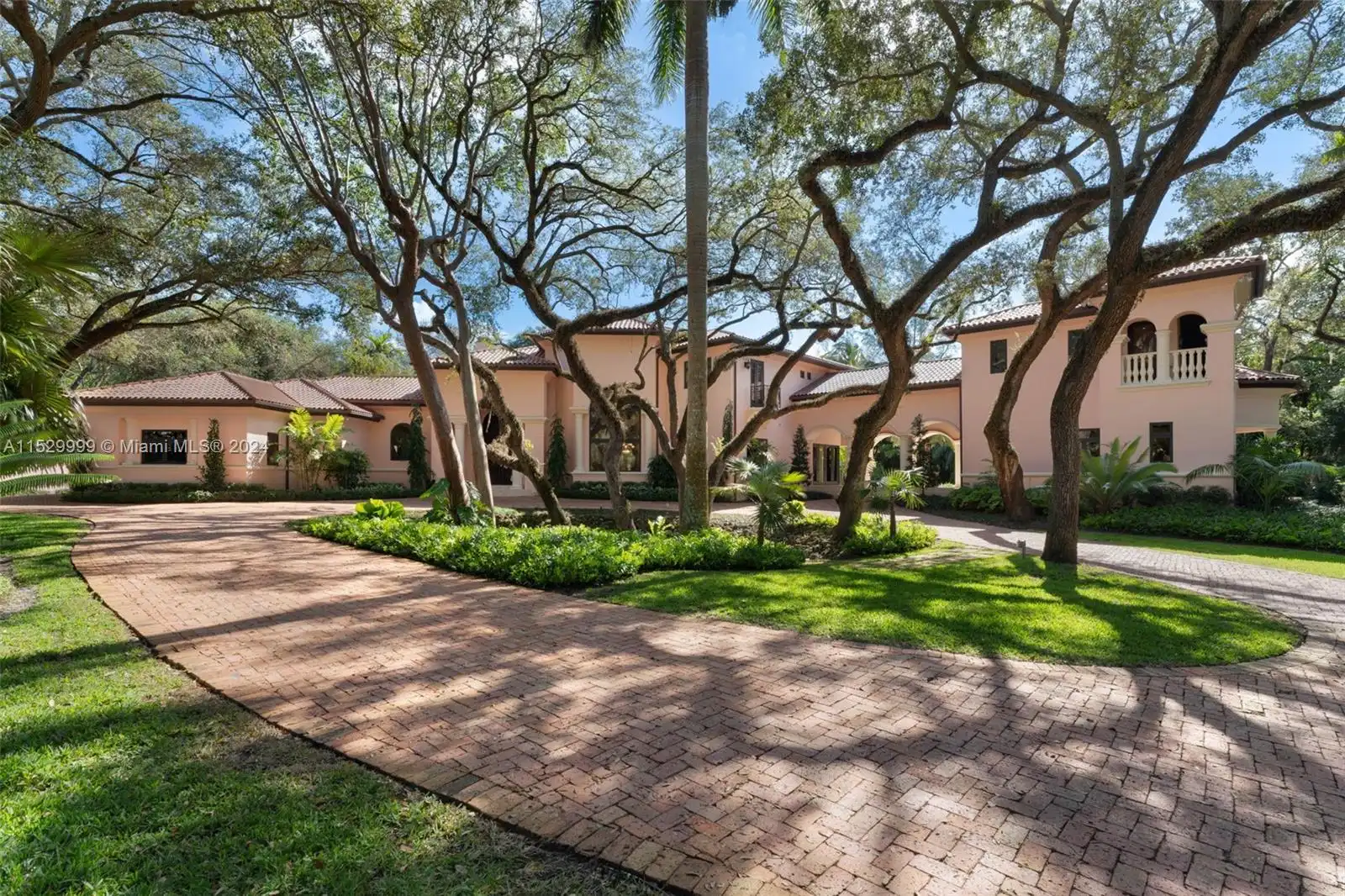
Here is the detail that matters and that generic guides consistently miss: community and brokerage material describes a single bridge between the channel and Biscayne Bay. Snapper Creek Lakes is a genuine boating community, but it is not a no-bridge community in the sense that Gables Estates or Old Cutler Bay are. For a center console or a modest express cruiser this is irrelevant. For a sportfish with a tower or a motor yacht with a flybridge, it is the whole conversation.
What the Snapper Creek Lakes membership application actually requires
This is the one approval process in the corridor whose terms are published in full by the club itself, in its New Member Application. Because they are documented rather than rumored, they are worth stating precisely. The application must be returned to the club administrator with a non-refundable application fee of 100,000 dollars payable to Snapper Creek Lakes Club, Inc., together with a signed copy of the purchase contract. The contract itself must contain the sentence: “This Contract is subject to the purchaser’s being approved and accepted into the membership of Snapper Creek Lakes Club, Inc.”
The application requires four sponsors who are personally acquainted with the applicant and are voting members in good standing, and the club states that an application cannot be accepted or processed without them. The seller may not act as a sponsor; neighbors of the seller are the preferred sponsors, and the board encourages the seller to host a meet-and-greet introducing the buyer to neighbors. At least two and preferably three banking references are required, along with letters of recommendation from every reference and sponsor. Once the application is complete, an admission committee interview takes place, and both the prospective voting member and spouse must be interviewed. An applicant who is not a United States citizen or entity, or who has not held permanent United States residence for at least two years, pays an additional 5,000 dollar investigative fee. A lease application carries its own non-refundable fee of 10,000 dollars. Separately, the club charges architectural processing fees of 1,000 dollars for new home construction, 500 dollars for a remodel and 250 dollars for each submittal thereafter, and requires an oak tree landscape survey completed within 30 days of submission.
Diligence note: verify the water before you fall in love with the house
Four items decide whether a dock will actually hold the boat a buyer intends to keep, and none of them appear in a listing description:
- Fixed bridge clearance. Measured at a stated tide condition. One bridge anywhere in the route caps air draft permanently.
- Controlling depth at mean low water. Canal depth is not uniform. The shallowest point in the route governs, not the depth at the seawall.
- Seawall condition, elevation and ownership. Repair and replacement obligations, permitting jurisdiction and any elevation requirements should be identified in writing during the inspection period.
- Turning basin and slip geometry. A 90 foot vessel needs somewhere to turn around, and canal segments differ.
We commission a marine survey of the dock and the route, not just a home inspection, on every waterfront transaction where the buyer intends to keep a significant vessel.
Old Cutler Bay, Gables by the Sea and Hammock Oaks: where the boating market has room
Not every buyer wants a membership application, a board presentation and a two-acre lawn. These three communities carry real gates, real dockage and materially more transaction volume, which makes them the practical entry to guard-gated waterfront life in Coral Gables.
Old Cutler Bay
Old Cutler Bay sits along the Old Cutler Road corridor in southern Coral Gables, near Matheson Hammock Park and Fairchild. Its own homeowners association describes the neighborhood as established in the 1960s and comprised of “just over 100 single family homes, many of which sit on wide canals with direct access to Biscayne Bay and no fixed bridges.” Third-party community pages report a larger figure, 136 homes across about 150 acres, and the two counts have not been reconciled publicly. Product ranges from an original mid-century house on a good lot to a full modern rebuild.
Three governance facts make Old Cutler Bay unusual and are worth stating plainly, because they change the buying experience.
First, the association is voluntary. The HOA states on its own site that it was formed in the 1980s, that membership is voluntary, and that it focuses on communication, security, landscaping and community events “rather than regulating property ownership or home purchases.” There is no approval gate on a purchase or a lease. Second, the community still runs a real security operation: a 24-hour guard-gated entrance with continuous roving patrols and a guard house equipped with cameras that record vehicles entering and leaving. A separate Old Cutler Bay Security Guard Special Taxing District exists and was the subject of a resident ballot on transferring its governing body to the City of Coral Gables under County Resolution R-1023-17 and City Resolution R2017-88. Third, there is no separate architectural review board. The HOA states that construction and exterior modifications are governed directly by the City of Coral Gables, so a buyer planning a rebuild deals with the city rather than with two layers of review.
The result is a guard-gated waterfront community with no approval gate and no association design committee. For a buyer on a timeline, or one who simply does not want to sit for a membership interview, that combination is meaningful and it is rare in this corridor.
Gables by the Sea
Gables by the Sea is the largest of the group, running along Old Cutler Road on the southern edge of Coral Gables adjacent to Matheson Hammock. How large is genuinely contested: published counts range from roughly 360 residences to roughly 417 to roughly 520, depending on whether the source is counting the neighborhood association’s boundary or a broader listing geography. The community is canal-centric: the majority of homes are canal-front or bayfront with deepwater dockage, and community material reports direct access to Biscayne Bay with no bridges. Multiple community and brokerage sources describe a 24-hour guarded entrance. Architecture ranges from Mediterranean Revival to mid-century to new modern construction, which is unusual in this corridor and is part of the appeal.
Because the community is larger and includes interior as well as waterfront lots, the price spread is the widest in this guide. Published figures place interior, non-waterfront homes well below full sea-access addresses.
Hammock Oaks and Hammock Lakes
Hammock Oaks and Hammock Lakes sit off Old Cutler Road just south of Fairchild. Published home counts range from about 100 to about 160 across the two, and lot and home size figures vary enough between sources that we treat them as unverified until pulled from county property records. A group of properties is lakefront, and a smaller group holds docks near a private marina area with access to Biscayne Bay through one bridge. Architecturally the area runs from 1960s traditional to contemporary rebuild.
This is the value pocket of the corridor. Buyers who want the canopy, the Old Cutler location and a boat, but who do not need a no-bridge deep-water lot or a membership process, look hard here.
What does no-bridge dockage actually mean, and why does it change the price?
No-bridge means that a vessel can travel from a private dock to open Biscayne Bay without passing under a fixed structure. It is the single largest driver of value differentiation inside these communities, and it is routinely misunderstood by buyers arriving from markets where the water is a view rather than a driveway.
A fixed bridge sets a permanent ceiling on air draft: the height of the tallest point of the vessel above the waterline, including the tower, the arch, the antennas and the tuna tower. Unlike controlling depth, which can sometimes be addressed through dredging with the right permits, a fixed bridge cannot be negotiated, improved or waited out. It is a permanent characteristic of the address. That permanence is why the market prices it so aggressively.
The practical consequence is that two homes of similar size and finish, on the same street, can sit in entirely different price tiers because one has no-bridge access and the other does not. It is also why a buyer who does not own a large vessel should still care: the buyer at resale may, and no-bridge inventory in Coral Gables is finite and cannot be expanded.
Why this corridor holds its position
The supply of guard-gated, no-bridge, deep-water estate lots in Coral Gables was set decades ago and cannot be increased. Gables Estates has 192 lots, a figure the club itself publishes. Journey’s End has 18. Tahiti Beach has fewer than 30. Snapper Creek Lakes has 124, of which only 6 are reported to have direct bay access. No amount of demand creates another sea-walled canal system with direct bay access inside a staffed gate, and no new development in Miami-Dade can replicate the 1920s and 1960s land assemblies that made these communities possible. Scarcity here is structural, not cyclical. What changes over a cycle is which enclave the demand concentrates in, and reading that rotation correctly is the difference between selling well and selling adequately.
How do the approval and membership processes actually work?
Where a community requires approval, the process is usually similar in shape even when the specifics differ. Understanding the shape lets you build a contract that survives it.
The sequence
An application package goes to the club or association. It typically requires sponsors who are existing members in good standing, financial and banking references, an accounting of other club affiliations, personal letters of recommendation, and a non-refundable fee paid at submission. A board or membership committee reviews the package, often with an in-person interview. The board then votes. Only after admission can the sale close.
Snapper Creek Lakes is the clearest published illustration, because its application spells out every step: four member sponsors, the seller barred from sponsoring, banking references, letters of recommendation from all references and sponsors, an admission committee interview of both spouses, and required contract language subjecting the contract to membership approval. Treat that as the shape of the process generally, while confirming each community’s own terms, because they differ in ways that matter.
What this means for a contract
Three things belong in the contract from the first draft. The approval contingency, drafted specifically rather than borrowed from a condominium association rider, and in Snapper Creek Lakes drafted in the exact words the club requires. A realistic outside date tied to the board’s actual meeting calendar rather than to a generic 30 days: the Gables Estates Club Board of Governors, for example, meets a minimum of four times a year, with its semi-annual meeting in April and its annual meeting in November. And clear language on deposit disposition if approval is not granted, since the application fee is separately non-refundable and the parties need to know who carries which risk.
Where sponsorship comes from
The sponsor requirement is the part buyers cannot solve alone. It is also, candidly, where a firm’s tenure inside a specific gate matters more than its marketing. Relationships built over four decades of transacting in the same communities are the practical mechanism by which a qualified buyer gets properly introduced. We will not characterize how any board will decide, and no one credible should. What we can do is make sure a package is complete, accurate and presented in the way that community expects.
How should a waterfront buyer approach flood zones and insurance here?
This is the question buyers most often ask last and should ask first. It deserves a straight answer rather than either reassurance or alarm.
Most waterfront parcels in these communities sit within a FEMA Special Flood Hazard Area, typically Zone AE, with the higher-energy coastal Zone VE appearing on the most exposed frontage. Zone AE carries a one percent annual chance of flooding and a published base flood elevation. A federally backed mortgage on a structure in a Special Flood Hazard Area triggers a federal flood insurance requirement. A cash purchase does not trigger that requirement, though carriers, lenders on any future refinance, and prudent practice all point the same direction.
Windstorm is a separate policy and a separate market from flood, and the two are now linked by statute. Under Florida Statute 627.715, Citizens Property Insurance Corporation, the state-backed insurer of last resort, is phasing in a requirement that its personal residential policyholders who carry wind coverage also carry flood insurance. The phase-in is keyed to the amount of dwelling coverage, with the highest coverage tiers required first and full compliance across affected policies required by January 1, 2027.
The work that actually reduces cost
Flood and wind pricing on a specific address is far more variable than most buyers expect, and several levers are within a buyer’s control during the inspection period. Pull the current FEMA flood map panel for the parcel rather than relying on a listing remark. Obtain an elevation certificate, which documents the finished floor elevation relative to the base flood elevation and frequently changes the rate materially. Ask whether the property may qualify for a Letter of Map Amendment if it sits naturally above the mapped flood elevation. Confirm the municipality’s Community Rating System class, which produces an automatic policyholder discount. Obtain a wind mitigation inspection, since roof shape, roof-to-wall connections, opening protection and roof deck attachment drive the windstorm premium. Then price a National Flood Insurance Program policy against private flood carriers, because on higher-value coastal homes the private market is often the better answer on both limit and price.
None of that is exotic. It is standard diligence on this product, and it belongs in the inspection period rather than in the week before closing. Insurance figures obtained early also give a buyer real negotiating information, which is the opposite of how most transactions handle it.
Two more items specific to this corridor
- Seawall obligations. Elevation, condition and maintenance responsibility vary by community and sometimes by lot. Identify the governing documents and the permitting jurisdiction during diligence, not after.
- Septic and sewer status. Portions of the Old Cutler corridor were developed on septic. Miami-Dade has been advancing conversion programs, and connection status, cost and timing should be verified for the specific parcel.
Which guard-gated community fits which buyer?
After 40 years inside these gates, the pattern we see is that buyers self-sort along four axes: the boat, the lot, the amenity appetite, and the tolerance for an approval process.
If the boat is the organizing principle and it is large, the conversation starts with Gables Estates, Journey’s End, Old Cutler Bay and Gables by the Sea, because no-bridge access is either present or absent and cannot be added later. If the household wants a club, tennis, a marina and a social calendar without leaving the gate, Cocoplum is the answer and there is no close second in this corridor. If the priority is land, quiet and a canopy, Snapper Creek Lakes and Journey’s End deliver acre and two-acre parcels that simply do not exist elsewhere this close to downtown Coral Gables.
If the timeline is compressed, or if an approval process is unappealing for privacy reasons, Old Cutler Bay stands out precisely because its own association states that membership is voluntary and that it does not regulate home purchases. And if the goal is to hold guard-gated waterfront in Coral Gables at the most accessible entry point, Hammock Oaks, Hammock Lakes and the interior sections of Gables by the Sea are where that entry exists today.
One final point that applies across all of them. These are thin markets. Gables Estates has 192 lots. Journey’s End has 18. In a market that small, the published comparable set is often two or three trades, half of them dated, and pricing off a per-square-foot average is how sellers leave money behind and buyers overpay. It is also why the price figures in this guide are presented as researched ranges with their sources named rather than as valuations: on a street where a no-bridge lot and a dry lot can sit in different price tiers, an average is an actively misleading number. The valuation work here is transaction-by-transaction, and it is the part of this business that does not scale and does not automate.
Frequently Asked Questions About Miami’s Guard-Gated Waterfront Communities
What are the best guard-gated communities in Miami?
Miami’s benchmark guard-gated waterfront communities are clustered along the Old Cutler Road corridor in Coral Gables: Gables Estates, Cocoplum, Tahiti Beach, Journey’s End, Snapper Creek Lakes, Old Cutler Bay, Gables by the Sea, and Hammock Oaks and Hammock Lakes. Gables Estates is the most restricted and the most expensive, and Zillow ranked it the most expensive neighborhood in the United States on data through July 2025. Its club states that membership is a prerequisite to purchasing property. Cocoplum carries the deepest amenity package, including a private marina, clubhouse and tennis. Journey’s End is the smallest, with eighteen estates on lots reported at more than an acre. Old Cutler Bay and Gables by the Sea offer no-bridge boating without a membership-approval gate. The right answer depends on how you intend to use the water.
What is the difference between a gated and a guard-gated community in Miami?
A gated community controls entry with a mechanical barrier: a clicker, a keypad, a call box or a resident transponder. Nobody is stationed there. A guard-gated community keeps a staffed post at the entrance around the clock, so every visitor, vendor and delivery is logged by a person rather than a device. The strongest Miami enclaves layer more on top of that: roving patrol vehicles, marine patrol on the canals and lagoons, camera coverage, and in some cases off-duty municipal police support. The operating cost of that staffing shows up in the assessment, which is one reason guard-gated communities carry higher recurring dues than simple gated ones.
Which Miami guard-gated communities have deep-water dockage with no fixed bridges to Biscayne Bay?
Gables Estates, Journey’s End, Old Cutler Bay and Gables by the Sea are the communities most consistently described as offering direct access to Biscayne Bay with no fixed bridges in the route. The Old Cutler Bay Homeowners Association states it directly, describing wide canals with direct bay access and no fixed bridges. Tahiti Beach, on its own island inside Cocoplum, also sits on open bayfront and canal. Snapper Creek Lakes and Hammock Oaks are the important exceptions: both are boating communities, but community and brokerage material describes a single bridge between the channel and the bay. Within Cocoplum itself, clearance varies by section. Bridge clearance is measured at a specific tide stage and should always be verified for the exact dock and the exact vessel.
Do you have to be approved to buy a home in Gables Estates?
Yes. Gables Estates Club, Inc. states on its own website that membership in the club is a prerequisite to purchasing property, so an executed contract alone is not enough to close. The club does not currently publish its application terms: as of July 2026 the membership and procedures documents on its applications page return a placeholder saying new documents are being uploaded. Community sources describe a non-refundable application fee reported at 100,000 dollars or more, resident sponsorship, a background and financial review, and board approval, and those figures should be confirmed with the club office rather than relied on. One published fact matters more than the fee: the club’s Board of Governors meets a minimum of four times a year, with a semi-annual meeting each April and an annual meeting each November, so approval timing belongs in the contract from the first draft.
How much does a home in Miami’s guard-gated waterfront communities cost?
The range is wide because the product is not uniform. Zillow’s analysis on data through July 2025 put the typical Gables Estates home value near 21 million dollars and ranked it the most expensive neighborhood in the United States. Researched listing ranges reviewed in July 2026 run roughly 2.3 million to 57 million dollars in Gables Estates, roughly 1.6 million to 19 million in Snapper Creek Lakes, and roughly 3.2 million to 32 million on Tahiti Beach, where trade press reported a March 2026 sale at 32 million as a community record. Gables by the Sea has the broadest entry, with interior lots reported well below waterfront addresses. Within any one community, a no-bridge deep-water lot and a dry lot on the same street can differ by many multiples. These are researched ranges, not appraisals, and current numbers should be confirmed for a specific address.
Is Tahiti Beach part of Cocoplum?
Yes. Tahiti Beach Island sits inside Cocoplum and is reached through a second, separate gate after the main Cocoplum entrance, which is what gives it the double-gate reputation. It is described across community and brokerage material as the only private gated island address in Coral Gables. Published counts of the homes there vary between roughly twenty and twenty-nine, and reported one-time association fees for the island are substantially higher than for the rest of Cocoplum. The name traces to George Merrick, whose Biltmore Hotel opened in January 1926 and offered guests gondola rides down the Coral Gables Waterway to a thatched-hut bayfront beach he called Tahiti Beach, worked by gondoliers brought from Venice. A gondola party on February 6, 1926 is the event most often cited.
Do guard-gated waterfront homes in Miami require flood insurance?
Federal law requires flood insurance on a federally backed mortgage when the structure sits in a Special Flood Hazard Area, which covers most waterfront parcels in these communities. A cash buyer is not federally required to carry it, but lenders, carriers and prudent practice generally point the same direction. Separately, Florida Statute 627.715 requires personal residential policyholders of Citizens Property Insurance Corporation who carry wind coverage to also carry flood insurance, under a phase-in keyed to dwelling coverage amount with full compliance required by January 1, 2027. The practical work is to pull the current FEMA flood map for the parcel, obtain an elevation certificate, and price both a National Flood Insurance Program policy and private flood alternatives before removing contingencies.
Who are the leading real estate specialists in Miami’s guard-gated waterfront communities?
The Audrey Ross Team at Compass Florida has worked inside these enclaves since the firm was founded in 1984 as Ross and Associates, Inc. Founder and CEO Audrey Ross is a Vice President of Compass, and the team reports more than 40 years in Miami luxury real estate and 2.4 billion dollars in lifetime closed volume. Recognitions include Best American Estate Agent for two consecutive years from Mercedes Benz and International Property Magazine of London, Florida’s Best Realtor of the Year from the Miami Herald, and the Luxury Real Estate Lifetime Achievement Award. Ten Luxury Real Estate Advisors work under Audrey from the team’s Coral Gables office at 4699 Ponce de Leon Blvd.
Considering a Guard-Gated Waterfront Address in Coral Gables?
Audrey Ross and the team have transacted inside Gables Estates, Cocoplum, Tahiti Beach, Snapper Creek Lakes, Journey’s End and Old Cutler Bay since 1984. We will walk you through the gate types, the approval calendars, the dockage realities and the comparables that actually apply. Discreetly, and at your pace.
Contact The Audrey Ross TeamGo Deeper on Miami’s Waterfront and Gated Markets
- Gables Estates: Guard-Gated Waterfront Community Guide
- Cocoplum Real Estate Guide: Guard-Gated Waterfront Living
- Deep-Water, No-Bridge Dockage in Miami: What It Costs and Where to Find It
- The Ultimate Guide to Living in Coral Gables, FL
- Pinecrest Real Estate Guide: Acre Lots and Family Estates
- Coconut Grove Real Estate Guide: Miami Village Luxury
- Moving to Miami: The Complete Relocation and Tax Guide
- Coral Gables vs Coconut Grove: Where Should You Live?
- Moving to Miami from New York: The Buyer’s Guide
Social Cookies
Social Cookies are used to enable you to share pages and content you find interesting throughout the website through third-party social networking or other websites (including, potentially for advertising purposes related to social networking).