

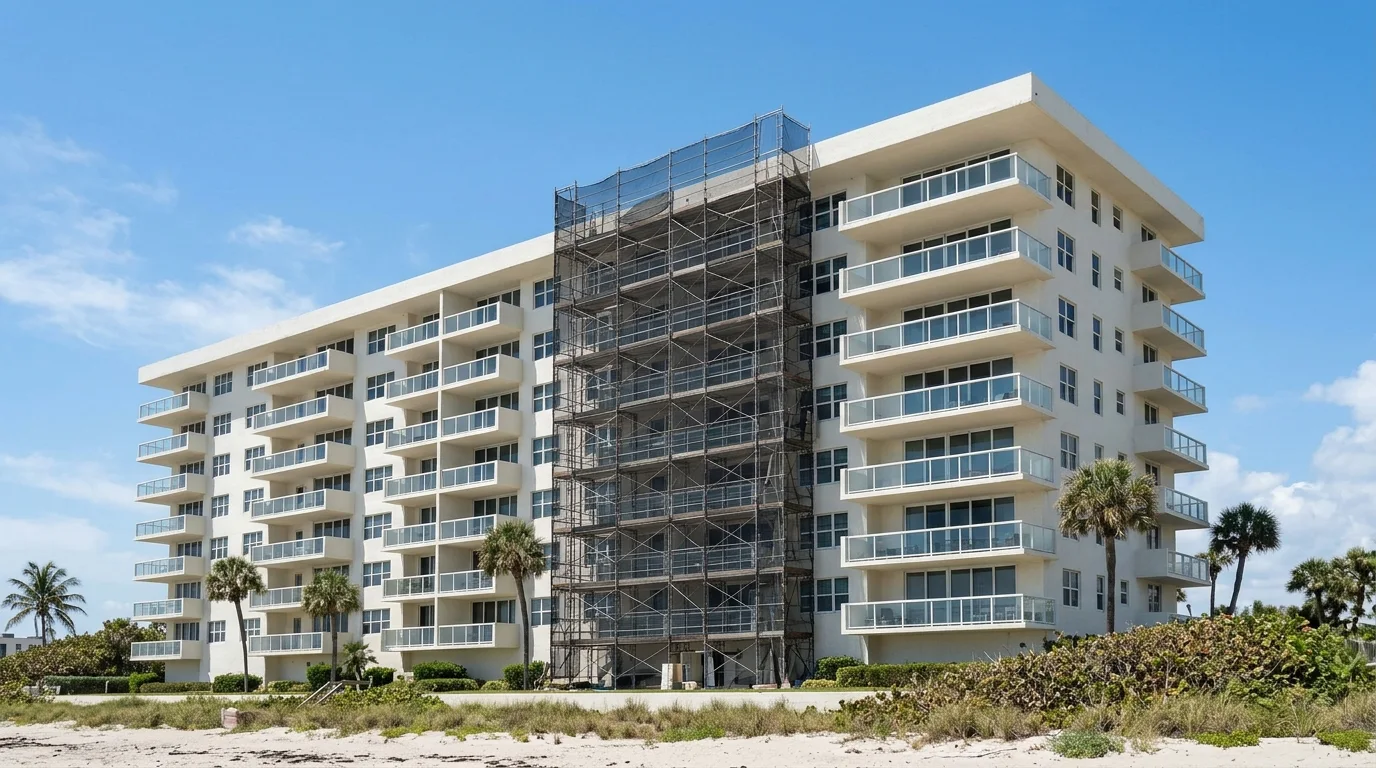
Florida’s post-Surfside condo rules for Miami buyers as of October 2026: milestone inspections, structural integrity reserve studies, the 7-day resale window, special assessments and condo financing. From The Audrey Ross Team at Compass Florida.
The Short Answer
Florida requires condominium buildings three habitable stories or taller to have a milestone inspection by December 31 of the year they turn 30 (25 in Miami-Dade for condominiums within three miles of the coastline built in 1998 or later) and a structural integrity reserve study every 10 years. Owners cannot waive those reserves in budgets adopted on or after December 31, 2024. As of October 2026, a resale buyer has 7 days, excluding weekends and legal holidays, to cancel.
Buying a condominium in Miami means buying a share of a building. When that building is 25 or 30 years old, the share includes its concrete, its roof, its reserve account and any repair bill the board has not yet sent. Florida rewrote the rules for those obligations after 2021 and changed them again in 2025. The asking price is one number. The milestone report, the reserve study and the board minutes tell you the rest.
We are The Audrey Ross Team at Compass Florida, and our office sits at 4699 Ponce de Leon Boulevard in Coral Gables. Audrey Ross opened her own firm in 1984, and the team has worked this market for more than 40 years. This guide explains the milestone inspection, the reserve study, what a resale buyer must receive, and how assessments and financing work in a building under repair, as of October 28, 2026.
What Happened at Champlain Towers South in Surfside?
On June 24, 2021, Champlain Towers South, a 12-story condominium with a penthouse built in 1981 on the Atlantic coast in Surfside, partially collapsed, and 98 people lost their lives, according to the National Institute of Standards and Technology (NIST).
NIST released its technical findings on June 22, 2026. The collapse began in early June 2021, when two connections between garage columns and the pool deck slab failed, and over three weeks the load shifted to slab-column connections that were not strong enough to carry it. NIST traces the narrow margins against failure mainly to deviations in the original structural design from the codes of the day and to construction that departed from the drawings, with added loads and corrosion reducing them further. Its final report is still being written.
Senate Bill 4-D, chapter 2022-269, Laws of Florida, approved and effective May 26, 2022, created the milestone inspection and the structural integrity reserve study. The Legislature amended both in 2023, 2024 and 2025.
What Is a Milestone Inspection, and Which Buildings Need One?
A milestone inspection is a structural inspection of a condominium or cooperative building by a Florida-licensed architect or engineer, required by section 553.899, Florida Statutes, by December 31 of the year the building turns 30 and every 10 years after that.
It applies to buildings three habitable stories or more in height that are subject, in whole or in part, to condominium or cooperative ownership. Age runs from the certificate of occupancy. A local enforcement agency may set a 25-year trigger where local conditions, such as proximity to salt water, call for it. Buildings of one to four dwelling units with three or fewer habitable stories are exempt. Buildings already 30 before July 1, 2022 had to complete a first inspection before December 31, 2024, and those reaching 30 between July 1, 2022 and December 31, 2024 had until December 31, 2025.
Phase one is a visual examination of the structure, completed within 180 days of the local agency’s notice. Phase two, which may include destructive or nondestructive testing, is required only if phase one finds substantial structural deterioration: substantial structural distress or substantial structural weakness that negatively affects the building’s general structural condition. Cracks, signs of leakage and peeling finishes do not count unless the inspector finds they signal it. The inspection is not a Florida Building Code compliance review.
| Step | Requirement | Deadline |
|---|---|---|
| Notice to owners | Association tells owners the inspection is due | 14 days after the local agency’s notice |
| Phase one | Visual inspection, report to the building official | 180 days after the notice |
| Phase two | Testing where phase one found deterioration | Progress report 180 days after phase one report |
| Summary to owners | Delivered, posted on site, on the website if required | 45 days after each report |
| Repairs | Scheduled or commenced under local ordinance | Commenced within 365 days of phase two report |
| Next inspection | The cycle repeats | Every 10 years |
Source: The Florida Senate, sections 553.899 and 718.112(2)(h), Florida Statutes, 2026 statutes. Retrieved October 2026.
If proof of repairs for substantial structural deterioration does not reach the local agency in time, the agency must review whether the building is unsafe for human occupancy.
How Does Miami-Dade’s Building Recertification Fit In?
In Miami-Dade, the milestone inspection and the county’s building recertification run on one schedule. The county has required recertification since 1975 under Section 8-11(f) of its code, amended the program on June 1, 2022, and integrated it with the state law, according to the Miami-Dade Department of Regulatory and Economic Resources:
- Buildings built in 1982 or earlier that already had an initial recertification keep their established schedule.
- Condominium and cooperative buildings three stories or taller within three miles of the coastline, built from 1983 through 1997, and all other buildings built from 1983 through 1992, had to recertify by December 31, 2024, then every 10 years.
- Those coastal condominium and cooperative buildings built in 1998 or later recertify at 25 years, then every 10 years.
- All other buildings built in 1993 or later recertify at 30 years, then every 10 years.
The county program covers every building except one- and two-unit residences and buildings with an occupant load of 10 or less and 2,000 square feet or less. Reports are due within 90 days of the county’s notice, and repairs must be permitted before a building can be recertified. In unincorporated Miami-Dade, a missed recertification draws a county citation with a $510 initial penalty, and an uncorrected violation can accumulate penalties of up to $10,000 per violation and a lien.
Each of Miami-Dade’s 35 municipalities runs recertification through its own building official, and the county handles unincorporated areas, where folio numbers begin with 30. A Brickell tower is in the City of Miami, whose Building Department’s Unsafe Structures Section handles recertification. Current Brickell listings are on our Brickell page.
What Is a Structural Integrity Reserve Study?
A structural integrity reserve study, or SIRS, is a reserve study based on a visual inspection of the components that hold a condominium up and keep water out, with a funding plan the budget must follow. Section 718.112(2)(g), Florida Statutes, requires one at least every 10 years for each residential condominium building three habitable stories or higher. It must cover:
- Roof; structure, including load-bearing walls and primary structural members and systems; fireproofing and fire protection systems; plumbing; electrical systems.
- Waterproofing and exterior painting; windows and exterior doors.
- Any other item whose deferred maintenance or replacement cost exceeds $25,000, or the inflation-adjusted figure, if its failure would harm the items above. The state posted $25,675 as the 2026 threshold.
A Florida-licensed engineer or architect, or a certified reserve specialist or professional reserve analyst, must perform or verify it. For each item it states remaining useful life and replacement cost or deferred maintenance expense, and it must recommend at least a baseline funding plan that keeps the reserve cash balance above zero in every budget year. Items with more than 25 years of remaining life need no replacement reserve, but the association must reserve any deferred maintenance expense the study recommends for them.
Owner-controlled associations existing on or before July 1, 2022 had to complete a first SIRS by December 31, 2025. An association with a milestone inspection due on or before December 31, 2026 may complete the SIRS with it, but no later than that date. Within 45 days of receiving the study, the association must give owners a copy or a notice of availability and report completion to the Division of Florida Condominiums, Timeshares, and Mobile Homes.
Hypothetical, with round numbers: a SIRS prices a roof replacement at $1,200,000 with 12 years of remaining life, and the roof reserve is empty. A straight-line plan sets aside $100,000 a year. In a 100-unit building where each unit carries an equal 1 percent share, that is $1,000 per unit per year, about $83 a month, for the roof alone.
Can a Condo Association Still Waive or Underfund Its Reserves?
Not for the structural items. For a budget adopted on or after December 31, 2024, owners in a unit-owner-controlled association that must have a SIRS cannot vote to provide no reserves, or less than required, for the SIRS items, or spend those reserves on anything else. Reserves for other items can still be waived by a majority of the total voting interests. The statute leaves defined exceptions:
- A multicondominium association may use an alternative funding method approved by the Division.
- Owners who vote to terminate the condominium under section 718.117 may also waive SIRS reserves.
- If the building official finds the entire building uninhabitable after a natural emergency, the board may pause contributions until it is habitable.
- For a budget adopted on or before December 31, 2028, an association that completed a milestone inspection within the previous two calendar years may, with a majority of the total voting interests, pause or reduce reserve contributions for up to two consecutive annual budgets to fund the recommended repairs, then must obtain a new SIRS before resuming. Developer-controlled and bulk-buyer-controlled associations, and those under owner control for less than a year, cannot use this pause.
- After a milestone inspection, an association may delay a required SIRS for up to the two budget years that follow.
SIRS reserves may be funded by regular assessments, special assessments, lines of credit or loans; the last three need a majority of the total voting interests. A loan or line of credit must cover all previously waived or unfunded reserves and must appear in the annual financial statement that a seller must hand a prospective buyer.
The Takeaway
A reserve that cannot be waived is a cost that cannot be deferred. In an older building, the SIRS funding plan shows what the monthly assessment is about to become, and the milestone report shows whether a special assessment may come first. Read both before you agree on a price.
What Did the 2025 Condo Law Change, and Did Anything Change in 2026?
House Bill 913, chapter 2025-175, Laws of Florida, approved June 23, 2025, took effect July 1, 2025, except where it set another date. The Florida House final bill analysis summarizes it.
| Change | Rule as of October 2026 | Effective |
|---|---|---|
| First SIRS deadline | December 31, 2025, extended from December 31, 2024 | July 1, 2025 |
| Resale review window | 7 days, excluding Saturdays, Sundays and legal holidays, up from 3 | July 1, 2025 |
| Reserve pause after a milestone inspection | Up to two annual budgets, budgets adopted through December 31, 2028 | July 1, 2025 |
| SIRS delay after a milestone inspection | Up to two budget years | July 1, 2025 |
| Alternative funding | Any multicondominium association, with Division approval | July 1, 2025 |
| Reserve item threshold | $25,000, inflation-adjusted, up from $10,000 | July 1, 2025 |
| Loans and special assessments for reserves | Allowed with an owner majority | July 1, 2025 |
| Association websites | 30-day posting deadline added; 25-unit threshold from the 2024 law applies | July 1, 2025; January 1, 2026 |
Source: Laws of Florida, chapter 2025-175 (CS/CS/HB 913), approved June 23, 2025; Florida House of Representatives, Final Bill Analysis, June 26, 2025; Florida Statutes, 2026. Retrieved October 2026.
The 2026 Legislature did not change these rules. The only 2026 act amending sections 718.112 and 718.503 was the reviser’s bill, Senate Bill 104, chapter 2026-14, approved March 30, 2026, which corrected cross-references. Other 2026 condominium bills, including House Bill 657 and Senate Bills 722 and 1498, died on March 13, 2026. As of October 28, 2026, the 2025 rules stand.
What Must a Condo Seller Give You, and How Long Do You Have to Cancel?
Under section 718.503(2), Florida Statutes, a resale buyer under contract is entitled, at the seller’s expense, to eight documents, and as of October 2026 may cancel by written notice within 7 days, excluding Saturdays, Sundays and legal holidays, after both signing and receiving them:
- The declaration of condominium, the articles of incorporation, and the bylaws and rules.
- The annual financial statement and annual budget.
- The inspector-prepared summary of the milestone inspection report, if applicable.
- The most recent SIRS, or a statement that none has been completed.
- The turnover inspection report, for a turnover inspection on or after July 1, 2023.
- The Frequently Asked Questions and Answers document.
If the buyer received the core documents more than 7 such days before signing, the contract may say so instead. A waiver of the cancellation right has no effect, the buyer may extend closing by up to 7 days, excluding Saturdays, Sundays and legal holidays, after receiving the documents, and the right ends at closing. If the association was required to complete a milestone inspection or SIRS and has not, the contract must say so in conspicuous type. Seven days excluding weekends is at least nine calendar days: hypothetically, a buyer who signs and receives the packet on a Monday, with no holiday in the next two weeks, has until the following Wednesday.
The Trap to Avoid
The statutory packet does not include board minutes, proposed special assessments, association loan documents or insurance policies, and its milestone document is the inspector’s summary, not the full report. Ask for the full report, 12 months of approved minutes and every pending or proposed assessment with the statutory documents, so you read them inside the 7-day window rather than after it closes.
How Do Special Assessments Work in a Miami Condo?
A special assessment is levied for a specific purpose, and each unit pays the share of common expenses its declaration assigns under section 718.115, Florida Statutes. Under section 718.112(2)(c), notice of a meeting where assessments will be considered must say so and give the estimated cost and purposes. Under section 718.116, the money may be used only for the purpose in the written notice.
Section 718.116 also makes a new owner jointly and severally liable with the previous owner for unpaid assessments due up to the transfer of title. The association must issue an estoppel certificate within 10 business days of a request. It itemizes assessments owed and those due during its effective period, 30 days if delivered by hand or electronically and 35 days by mail, and lists contacts for the association’s insurance. Our seller’s guide covers the estoppel from the seller’s side. Who pays installments of an assessment adopted before closing, or one still proposed, is a contract term, negotiable, and should be written into the contract.
Hypothetical, with round numbers: a phase two inspection leads to $10,000,000 of concrete and waterproofing repairs, assessed in full. A unit with a 0.5 percent declaration share owes $50,000. If the seller has paid $20,000 by closing, the estoppel shows what is owed now and what falls due within its effective period; the board’s notice shows later installments, and the contract decides who pays the remaining $30,000.
Can You Get a Mortgage on a Condo in a Building Under Repair?
Not a loan sold to Fannie Mae while critical repairs remain unaddressed. Fannie Mae Selling Guide section B4-2.1-03, dated August 5, 2026, makes a project ineligible while it needs repairs that significantly affect the soundness, structural integrity or habitability of its buildings, or its financial viability. Conditions include:
- Material deficiencies that could contribute to failure of a critical element or system within one year.
- Mold, water intrusion or potentially damaging leaks, or advanced physical deterioration.
- Failure to pass a mandatory state, county or other inspection or certification for structural soundness and habitability.
- Unfunded repairs over $10,000 per unit that should be undertaken within 12 months, not counting repairs funded through a special assessment.
If a special assessment is tied to a critical repair that has not been remediated, the project is ineligible. A structural or mechanical inspection completed within three years of the lender’s review must be read. An evacuation order, pending litigation over structural soundness or habitability, unless it fits the Guide’s exceptions for minor matters, or a termination vote also disqualifies a project. Routine, preventive capital work is not a critical repair.
A building whose special assessment funds a critical repair, such as structural concrete restoration, stays ineligible until the work is complete and an engineer’s report or similar document shows it resolved. A buyer then has to pay cash, wait, or find a portfolio lender that keeps the loan rather than selling it. Ask the lender before you sign, and set the financing contingency long enough for an answer. Buyers purchasing from abroad should also read our foreign buyer guide.
Hypothetical, with round numbers: a 100-unit building’s minutes show $1,500,000 of structural repairs due to start within 12 months and not funded. That is $15,000 per unit, above the $10,000 line. If the board then funds the work by special assessment, the per-unit test no longer applies, but an assessment tied to a critical repair keeps the project ineligible until the work is done.
Which Condo Documents Should You Collect Before You Commit?
Collect the statutory packet plus the records that show what the building is about to spend. A condominium with 25 or more units must post most of them on its website under section 718.111(12)(g), Florida Statutes, but only owners get the login, so ask the seller to pull them.
| Document | What to look for | Where it comes from |
|---|---|---|
| Milestone report and summary | Phase two findings, repairs, deadlines | Seller; association website |
| SIRS | Remaining life, cost, annual reserve | Seller packet; DBPR filing list |
| Budget and financial statement | Reserves against the SIRS plan; loans | Seller packet |
| Special assessments | Adopted amounts and installments; proposed items | Estoppel; meeting notices |
| Board minutes, 12 months | Engineering updates, bids, insurance renewals | Website; seller |
| Insurance | Carriers, coverage, renewal dates | Estoppel contacts; policy pages |
| Litigation | Suits over structure or construction | Minutes; court records |
| Permits and recertification | Open work; passed, pending or overdue | Website; building official |
Source: sections 718.111(12)(g), 718.116(8) and 718.503(2), Florida Statutes, 2026; Fannie Mae Selling Guide B4-2.1-03, August 5, 2026. Retrieved October 2026.
How Do You Check a Specific Building’s Status?
Start with the building official for the city where the building sits. The Miami-Dade Property Appraiser links a list of municipal building contacts, the county’s recertification portal shows cases in unincorporated Miami-Dade, and the City of Miami lists its contacts on its recertification page.
The state publishes a SIRS Reporting Database, with entries displayed exactly as each association submitted them. A building that should be listed and is not is a question to put to the association in writing. Beyond the documents chapter 718 requires, an association may charge a prospective buyer up to $150, plus copying and attorney’s fees, for other answers. If you are relocating, our relocation and tax guide covers homestead and insurance timing.
What Does the Miami-Dade Condo Market Look Like Now?
In September 2026, Miami-Dade condo sales rose 1 percent year over year, the median price dipped and listings fell, according to MIAMI REALTORS + RWorld, which reports from its MLS.
| Measure | September 2026 | September 2025 |
|---|---|---|
| Condo sales | 909 | 904 |
| Median condo price | $417,090 | $420,000 |
| Condo listings | 11,706 | 12,620 |
Source: MIAMI REALTORS + RWorld, Miami-Dade statistics for September 2026, released October 16, 2026. Retrieved October 2026.
MIAMI REALTORS put existing condo inventory at 12.3 months, which it calls a buyer’s market, with cash in 49.4 percent of existing condo sales. These countywide figures do not separate buildings by age or repair status, so a unit’s value still comes from recorded sales in its own building.
The Sequence That Works
Read the milestone summary and the SIRS before you make an offer. Ask for the minutes and every proposed assessment with the statutory packet. Confirm with your lender that the project qualifies before the financing contingency runs. Then price the unit against the building’s next five years of assessments, not just its last sale.
Frequently Asked Questions About Buying a Miami Condo After Surfside
What is a milestone inspection in Florida?
A milestone inspection is a structural inspection required by section 553.899, Florida Statutes, for condominium and cooperative buildings three habitable stories or taller, due by December 31 of the year the building turns 30, or 25 where the local agency sets it, and every 10 years after. Phase one is a visual review by a licensed architect or engineer. Phase two follows only if phase one finds substantial structural deterioration, and repairs must start within 365 days of that report.
Which Florida condos need a structural integrity reserve study?
As of October 2026, section 718.112(2)(g), Florida Statutes, requires every residential condominium association to complete a structural integrity reserve study at least every 10 years for each building three habitable stories or higher. It covers the roof, structure, fire protection, plumbing, electrical, waterproofing and exterior painting, windows and exterior doors, and any other item costing more than $25,000, adjusted to $25,675 for 2026, whose failure would harm those components. Owner-controlled associations existing on or before July 1, 2022 had until December 31, 2025.
Can a Florida condo association waive its reserves in 2026?
Not for structural items. Under section 718.112, Florida Statutes, for budgets adopted on or after December 31, 2024, owners in an association that must have a structural integrity reserve study cannot waive or underfund reserves for its items. The main exception is a pause of up to two annual budgets after a milestone inspection, approved by a majority of the total voting interests, for budgets adopted through December 31, 2028. Other reserves can still be waived by that majority.
How many days do I have to cancel a Florida condo resale contract?
As of October 2026, section 718.503(2), Florida Statutes, gives a condominium resale buyer 7 days, excluding Saturdays, Sundays and legal holidays, to cancel by written notice after signing and receiving the required documents, unless they were received more than 7 such days before signing. House Bill 913 raised the window from 3 days effective July 1, 2025. A waiver has no effect, and the right ends at closing.
What documents should I get before buying a condo in Miami?
Under section 718.503(2), Florida Statutes, a Miami condominium resale buyer receives the declaration, articles, bylaws and rules, the annual financial statement and budget, the milestone inspection summary, the latest structural integrity reserve study, any turnover inspection report, and the Frequently Asked Questions and Answers document. Ask as well for the full milestone report, 12 months of board minutes, adopted and proposed special assessments, loan terms, insurance details and any litigation.
Did Florida change its condo laws in 2026?
Not in substance. As of October 28, 2026, the only 2026 act amending sections 718.112 and 718.503, Florida Statutes, was the reviser’s bill, chapter 2026-14, approved March 30, 2026, which corrected cross-references. Bills including House Bill 657 and Senate Bills 722 and 1498 died on March 13, 2026. The milestone, reserve study and resale rules in force are those as amended by House Bill 913, chapter 2025-175, effective July 1, 2025.
Can I get a Fannie Mae mortgage on a Miami condo with a special assessment for repairs?
It depends on the repair. Fannie Mae Selling Guide section B4-2.1-03, dated August 5, 2026, makes a condominium project ineligible if a special assessment is tied to a critical repair not yet remediated, if it has unfunded repairs over $10,000 per unit due within 12 months, or if it failed a mandatory structural inspection. Routine capital work does not disqualify a project. Ask the lender to review the building before your financing contingency expires.
Who pays a condo special assessment when a Miami unit is sold?
The purchase contract decides who pays installments of a special assessment adopted before closing, and the point is negotiable. Under section 718.116, Florida Statutes, a new owner is jointly and severally liable with the seller for unpaid assessments due up to the transfer of title. The estoppel certificate itemizes amounts owed and amounts due during its 30-day or 35-day effective period, so read it with the board’s assessment notice.
Weighing a Condo in an Older Miami Building?
Before you commit to a price, talk with us about the milestone summary, reserve study and assessment history in front of you. Audrey Ross opened her own firm in Miami in 1984, and The Audrey Ross Team at Compass Florida has closed $2.4 billion in lifetime sales with ten Luxury Real Estate Advisors working from 4699 Ponce de Leon Boulevard in Coral Gables.
Contact The Audrey Ross TeamContinue Exploring Miami Real Estate
- Buying Miami Real Estate as a Foreign Buyer: The Complete Guide
- Coconut Grove Real Estate Guide: Miami Village Luxury
- How to Sell a Luxury Home in Miami: The Seller’s Guide
- Moving to Miami: The Complete Relocation and Tax Guide
- Moving to Miami from New York: A Complete Guide
- Brickell Real Estate Listings
Sources
- NIST, technical findings on the Champlain Towers South partial collapse, June 22, 2026.
- Laws of Florida, chapter 2022-269 (SB 4-D), May 26, 2022.
- The Florida Senate, Florida Statutes section 553.899, 2026 statutes.
- The Florida Senate, Florida Statutes section 718.112, 2026 statutes.
- The Florida Senate, Florida Statutes section 718.503, 2026 statutes.
- The Florida Senate, Florida Statutes section 718.111, 2026 statutes.
- The Florida Senate, Florida Statutes section 718.115, 2026 statutes.
- The Florida Senate, Florida Statutes section 718.116, 2026 statutes.
- Laws of Florida, chapter 2025-175 (CS/CS/HB 913), June 23, 2025.
- Florida House, Final Bill Analysis, CS/CS/HB 913, June 26, 2025.
- Laws of Florida, chapter 2026-14 (SB 104), March 30, 2026.
- The Florida Senate, HB 657 (2026), Community Associations, died March 13, 2026.
- The Florida Senate, SB 722 (2026), Condominium Structural Integrity Reserve Studies, died March 13, 2026.
- The Florida Senate, SB 1498 (2026), Community Associations, died March 13, 2026.
- Miami-Dade County RER, Recertification, October 2026.
- Miami-Dade County Property Appraiser, Building Recertification, October 2026.
- City of Miami, Get a Building Recertification, October 2026.
- Florida DBPR, SIRS Reporting and Database, October 2026.
- Florida DBPR, Reserve Threshold, 2026 threshold.
- Fannie Mae Selling Guide, B4-2.1-03, Ineligible Projects, August 5, 2026.
- MIAMI REALTORS + RWorld, September 2026 Miami-Dade statistics, released October 16, 2026.
Facts on this page were checked against the sources above in October 2026. This guide is general information, not legal, tax or financial advice. Confirm the details for your own situation with a Florida real estate attorney, a licensed engineer, your lender, or your title agent.
Social Cookies
Social Cookies are used to enable you to share pages and content you find interesting throughout the website through third-party social networking or other websites (including, potentially for advertising purposes related to social networking).